

WAKAYAMA · THE SHOYU ATLAS
From a single drop of soy sauce,
discover Japan.
A single drop that rounds out a dish, and a single spoonful savored on its own.
An encyclopedia of soy sauce and Kinzanji miso from Yuasa, Wakayama.
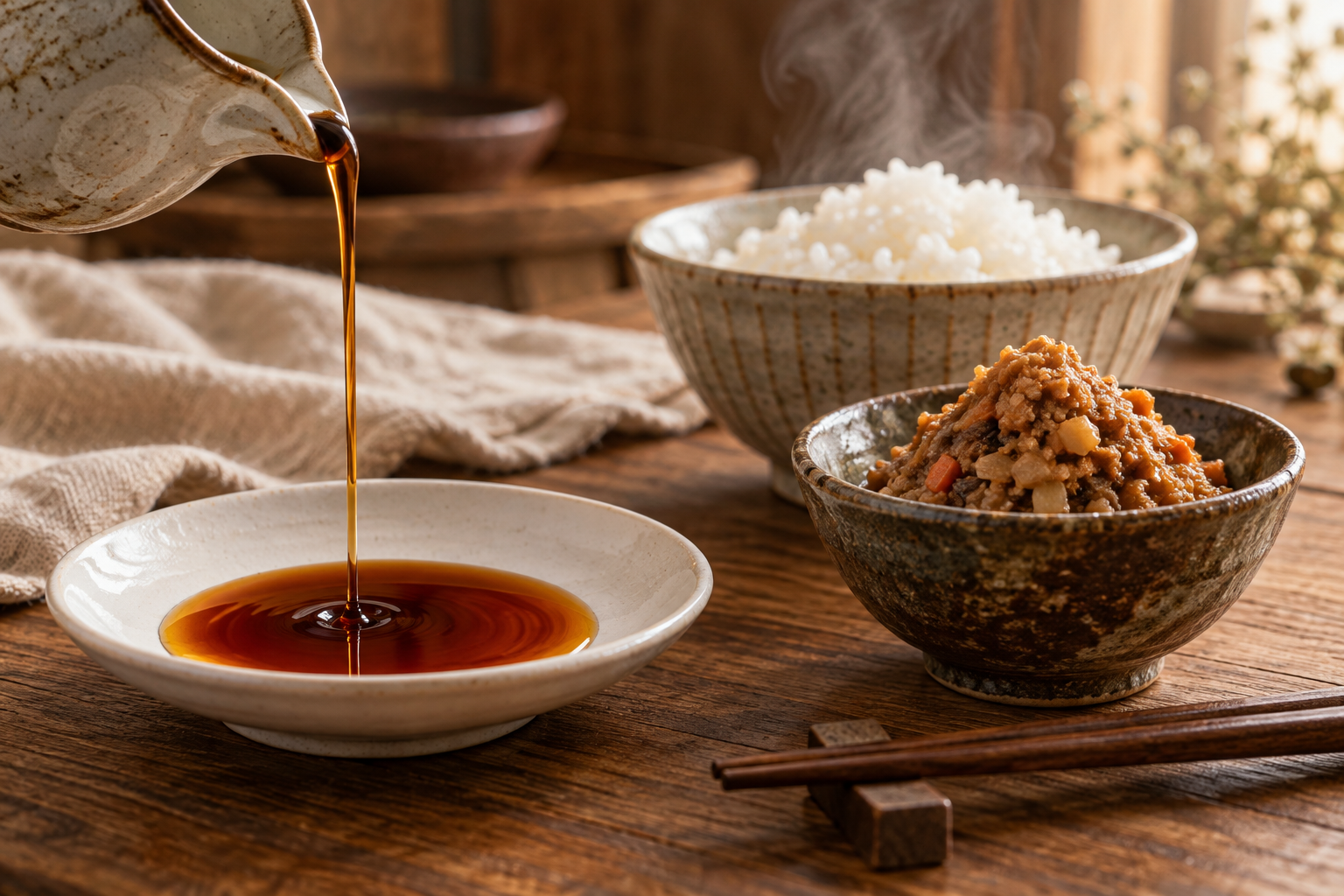
ONE DROP, ONE SPOONFUL
A single drop, a single spoonful.
A journey through Wakayama begins there.
A port town, the work of a brewery, the mystery of fermentation.
Open up what you want to know, starting from your everyday table.
Table of contents 14 CHAPTERS + 3 STORIES
SHOYU STORIES / 01
Before a Drop, a Spoonful.
Swipe sideways to read. The characters are fictional.
Read the Text Version of the Comic
1
Let’s explore the origins of soy sauce in Yuasa.
First, let’s start with miso you eat.
Kinzanji miso is a side-dish miso served alongside rice.
2
Did a monk bring it here?
There’s a legend that Kakushin brought back the method for making miso in 1254.
An image based on the legend.
3
This liquid became soy sauce?
It’s said that refinements were made repeatedly in Yuasa.
An image based on the legend.
4
So it was invented in 1254?
The exact date of invention hasn’t been proven.
Let’s separate the story from the confirmed historical record.
5
From this town, to many different places.
Ships connected goods, raw materials, and people alike.
The town developed as a center of brewing and commerce.
6
Kinzanji miso is also a star today.
Enjoy it without dissolving it — savor the chunks and ingredients.
It’s primarily a miso eaten as is.
SHOYU STORIES / 02
From Soybeans and Wheat to Soy Sauce.
Swipe sideways to read. The characters are fictional.
Read the Text Version of the Comic
1
It’s not just soybeans.
Koikuchi (dark) soy sauce is basically made from soybeans and wheat.
Salt and water are important too.
2
Is this koji?
Koji mold is cultivated to harness the action of enzymes.
An image illustrating koji mold and enzymes.
3
What happens when it’s combined with saltwater?
It becomes “moromi,” and fermentation proceeds.
The basic process for koikuchi and honjozo (traditionally brewed) soy sauce.
4
Is koji mold the only thing at work?
Lactic acid bacteria and yeast each have their own role too.
The personification of microorganisms is a metaphor used for explanation.
5
After waiting, does it go straight into the bottle?
The liquid is extracted from the aged moromi.
The extracted liquid is called kiage (raw pressed soy sauce).
6
There’s also nama shoyu (raw soy sauce), which isn’t pasteurized.
Even raw, hygiene is managed through other methods.
This is not a label guaranteeing live microorganisms or health benefits.
SHOYU STORIES / 03
Which Bottle for Today’s Dish?
Swipe sideways to read. The characters are fictional.
Read the Text Version of the Comic
1
Which one should I buy?
Let’s think about what you want to change in your cooking first.
Koikuchi, usukuchi, tamari, saishikomi, and shiro (white).
2
If you’re starting with just one bottle?
Koikuchi works both for dipping and for cooking.
Even within the same type, flavor varies by product.
3
Does usukuchi have less salt?
What’s light is the color. That’s separate from reduced salt.
Compare salt content using the same unit — salt equivalent.
4
Are tamari and saishikomi the same?
One is mainly soybean-based, the other is brewed using kiage. They’re different types.
Some tamari products also use wheat.
5
Is soybean the main ingredient in shiro shoyu too?
This one is primarily wheat-based. Suited to light-colored dishes.
Check the ingredients and allergy labeling.
6
For a taste comparison, do you drink a lot of it?
A small amount of the same ingredient each time is enough.
Check allergies and dietary restrictions first.
7
Do you just leave the rest sitting out on the table?
Check the storage instructions after opening, and buy only the amount you can use up.
Storage conditions may vary depending on the container.
Start here: six things you can grasp at a glance
Yuasa is a place that carries on both the legend surrounding the origin of soy sauce brewing and the townscape of a brewing industry. At the same time, the entire history of East Asia’s fermented seasonings cannot be explained by a single invention or a single drop. Let’s enjoy the stories handed down in the town while also looking closely at the differences among the actual products.010916
| What you want to know | The answer to remember first |
|---|---|
| How many types of soy sauce are there? | Under Japan’s JAS standard, there are five types: koikuchi (dark), usukuchi (light), tamari, saishikomi (twice-brewed), and shiro (white). This is a classification separate from product names. |
| Is usukuchi lower in salt? | What is light about it is mainly the color. That is a separate matter from being reduced-salt. |
| Is Kinzanji miso for miso soup? | It is mainly an “eating miso” enjoyed as is, savored for its chunky texture and ingredients. |
| Are the microbes in “nama shoyu” (raw soy sauce) still alive? | “Nama (raw)” is a label for products that have not been heat-treated. It is not a guarantee that live microbes are present. |
| Does using a wooden vat mean the flavor is always the same? | Ingredients, koji, management, aging, and finishing all play a part, so the vat alone does not determine the flavor. |
| Are Yuasa and Kokoku-ji the same place? | Yuasa is the brewing town. Kokoku-ji, associated with Kakushin, is in Yura, to the south. |
Classifications and labeling are based on the JAS standard and the Fair Competition Code, while eating customs and regional information are based on registration documents and official guides.0304051329
Once you understand what’s behind a name, the shelves become easier to read
“Koikuchi,” “honjozo,” “marudaizu,” and “Yuasa” are not names of the same kind. On a single label, information layers together: what category of soy sauce it is, how it was made, and what place or maker the product is tied to. Once you sort the names by their role, you’ll find the reason to choose one.0405
| Role of the label | Examples | What it tells you—and what it doesn’t |
|---|---|---|
| General classification of soy sauce | Koikuchi, usukuchi, tamari, saishikomi, shiro | Characteristics such as ingredient composition, method, and color. It is not a name that fixes the salt content of any single product. |
| Manufacturing method | Honjozo (genuine brewing), mixed brewing, mixed | How brewing is combined with things like amino acid liquid. It is not a ranking of health or price. |
| Description of ingredients and process | Marudaizu (whole soybeans), wooden-vat brewed, nama shoyu | The state of the soybeans, the vessel used for brewing, whether heat-treated or not, and so on. Each is a separate condition. |
| Region, maker, product | Yuasa, Kadocho, Mitsuboshi Soy Sauce | A gateway to the production area, the brewery, and the product. They should not be lined up on the same level and counted as “types.” |
| Registered name of a regional product | Kishu Kinzanji Miso | A registered name tied to a specific production area, characteristics, and method. It does not fall under the five classifications of soy sauce. |
The term “Yuasa shoyu” should also be read by separating the context in which it refers to soy sauce from the region in general, from the context in which it refers to the maker’s name, “Yuasa Shoyu Co., Ltd.” A place name alone does not mean everything is the same method or the same brand. Checking the product name and manufacturer listed on the back label is the first trick.01212327
Hishio, miso, tamari, shoyu: connected, but not the same
“Hishio” is a term you encounter when tracing old fermented seasonings. What materials it used and what range it referred to differed by era, so it cannot simply be treated as identical to a single bottle of soy sauce today. Miso and soy sauce are historically connected, but that does not mean every modern soy sauce is made by pressing commercially sold miso.0916
“Tamari” also has two uses: a general term for liquid that collects from miso and similar sources, and the JAS category name “tamari shoyu.” “Moromi” likewise appears both as the mash during brewing and as the name of the eating condiment “moromi miso.” Don’t let similarities in terminology cause you to swap one process or food for another.040725
Yuasa’s story continues on beyond a single drop
What has been passed down in Yuasa is the method for making Kinzanji miso, along with the story of soy sauce making that put to use the liquid that emerged from that process. In the Japan Heritage narrative, the Zen monk Kakushin (also known as Hotto Kokushi) is said to have traveled to Song-dynasty China in 1249 and returned in 1254. The storyline in which he transmitted the method of miso-making he had learned at Jingshan Temple links together the fermentation culture of Yura and Yuasa.01
He is said to have noticed the liquid that collected in the miso vats, used it as a seasoning, and further refined the process for extracting more of it. This is the story of the “first drop.” However, this should not be read as a proven event in which Kakushin invented today’s soy sauce on a single day. It is best savored as a legend set against the backdrop of the hishio culture of China and the brewing and seasoning history that developed in various regions across Japan.010916
Visit Yura for Kakushin, walk Yuasa for the brewing town
Kokoku-ji Temple is located in Yura. It does not stand next to the soy sauce breweries of Yuasa. By visiting the town’s commerce and the temple’s heritage separately, the stage of history comes into view not as a single point but as something spreading across the western coast of the Kii Peninsula.2901
What the port carried wasn’t only the finished soy sauce
An early-modern production area needed routes for procuring raw materials, salt, and containers, as well as markets for selling its products. Maritime shipping across the Kii Channel, Osaka Bay, and the Seto Inland Sea played a role in connecting all of this. Looking at salt making, wooden-vat making, and the work of merchants and brewers together reveals why a soy sauce town opened itself toward the sea.13
The Japan Heritage commentary explains that commerce developed under the protection of the Kishu domain, and that by the Bunka era (1804–1818), the town counted 92 brewing operators. This is not the current number of establishments, but the scale of prosperity at that time as conveyed by later commentary. The townscape that remains offers a gateway to reading that commerce and way of life.01
To Choshi, Noda, and Tatsuno: the same flavor didn’t simply spread as is
The movement of people and techniques from Kishu to the Boso region is an important thread connecting regional soy sauce history. Meanwhile, in the Kanto region, brewing developed in places like Choshi and Noda, tied to the tastes of consumer markets, raw materials, and transport conditions. Tatsuno, in the Kansai region, is a place to learn about the development of usukuchi. It’s more interesting not to treat each production area as merely a copy of Yuasa’s method—the differences are what make it fascinating.131415
Tracing the story and the record through a timeline
| Period | What can be traced | How to read the evidence |
|---|---|---|
| Ancient to medieval era | Fermented seasonings such as hishio and miso lie in the background connecting to modern soy sauce | The scope of terms and foods differed by era. This is separate from a birth year for modern soy sauce.0916 |
| 1249 / 1254 | The Japan Heritage story recounts Kakushin’s voyage to and return from Song China, and the transmission of the miso-making method | A legend adopted in present-day cultural heritage commentary. It is not a contemporaneous record of the invention of soy sauce.01 |
| 1487 / 1559 | Historical commentary introduces references related to tarumiso in the “Shijoryu Hochosho” and to shoyu in the “Tokitsugu-kyoki” | Later commentary introducing descriptions from old documents. The year a text was compiled and the age of the surviving edition are separate matters.09 |
| 1535 | Shipments of soy sauce from Yuasa to Osaka are described in the Japan Heritage commentary | Later commentary conveying Yuasa’s commercial history.01 |
| 1804–1818 | Yuasa is described as having 92 brewing operators | An explanation covering the Bunka era. Not the current number of businesses.01 |
| 1841 / 1866 | The founding of Kadocho, and the age of the building now tied to the present-day “Artisan Warehouse” | An account of the brewery’s and museum’s history.2122 |
| Modern to contemporary era | Brewing research, koji-making and temperature control, production equipment, and distribution continue to change | An explanation of technology and commerce based on regional surveys.1314 |
| 2017 | Yuasa is certified as Japan Heritage; on August 10, “Kishu Kinzanji Miso” is registered as GI No. 39 | Two separate systems. Don’t confuse the cultural heritage story with the protection of a regional product’s name.0235 |
| 2025 | Yuasa Shoyu Co., Ltd. announces the introduction of two new domestically made Japanese cedar wooden vats | An announcement from the company itself. It does not mean soy sauce from the new vats has already been completed.33 |
Can the old records of “shoyu” be compared by date alone?
The era when a text was compiled and the era of the edition we can read today are not the same.
When an old cookbook contains the character for “shoyu” (soy sauce), it’s tempting to treat the book’s compilation year as the word’s first recorded appearance. However, Otsuka Hideaki’s textual criticism points out the need to distinguish between descriptions in editions published in later ages and descriptions from the same era as the original. In materials that have been recopied or edited, the content can change even under the same title. This is not about hastily deciding whether China or Japan came first, but about considering what grounds we can use to discuss dates. The word’s first appearance, the food’s existence, and the establishment of the current production method are each separate issues.
Is 1254 the birthday of soy sauce?
It is the year of the story of the return home and the transmission of a production method, not proof of an invention date.
The Japan Heritage story introduces how Kakushin traveled to Song China in 1249 and returned home in 1254. This is the year linked to the legend that soy sauce production developed from making use of the liquid that collected in miso barrels. However, this explanation is not a record that today’s soy sauce was completed on that date. Introducing a venerable story is one thing, and confirming events through documents from the same era is another. If you enjoy the story while staying aware of how much of it is a record-based explanation, you can read the town’s history in a more three-dimensional way.
Does the “birthplace” claim contradict the fermented seasonings found around the world?
Sorting out what exactly “the beginning” refers to helps clarify things.
Even when we say “the beginning of soy sauce,” fermented foods like jiang, the innovation of using liquids for seasoning, production methods close to today’s, and brewing as an industry are not the same question. Yuasa’s Japan Heritage designation conveys both the origin story passed down locally and the story of a town built on the brewing industry. Researchers’ explanations, meanwhile, also cover fermented seasonings across East Asia including China, and the technological changes in various production regions within Japan. Rather than having one story explain every origin, focusing on the work and life that Yuasa has nurtured allows you to understand the character of the place without forcing things.
How do soybeans and wheat become a single drop?
The basics of honjozo (traditional brewing) are to cultivate koji mold on the raw ingredients, combine them with salt water, and extract the liquid through decomposition, fermentation, and aging. The main raw ingredients are soybeans, wheat, salt, and water. Here we look at the typical process for koikuchi (regular soy sauce). Not every type and every brewery uses the same proportions or number of days.040607
First, bringing the ingredients into a “workable condition”
Soybeans are processed by steaming and other methods, while wheat is prepared by its own method, such as roasting and crushing. Adding tane-koji (seed koji spores) to these and cultivating koji mold is called “seikiku” (koji-making). Koji is not made only from rice. In soy sauce, koji made by cultivating koji mold on soybeans and wheat plays the active role.0607
Soybean protein is the source of amino acids that lead to umami. The sugars produced from wheat starch contribute not only sweetness but also, through microbial fermentation, aroma and other qualities. Salt not only seasons the product but is also involved in the activity of the microorganisms during the mash-making process. Water dissolves the salt and creates the environment in which components and microorganisms work during production.06
Koji, moromi, shoyu: watching where the name changes
| Process | What happens? | What to notice here |
|---|---|---|
| Ingredient processing | Soybeans and wheat are processed by methods suited to each | Not a process where everything is boiled the same way |
| Koji-making (seikiku) | Adding tane-koji and cultivating koji mold | Cultivating the mold and utilizing the action of its enzymes |
| Mashing (shikomi) | Combining koji with salt water to form moromi | In re-brewed shoyu (saishikomi), raw unpasteurized shoyu is used instead of salt water |
| Fermentation and aging | Advancing the decomposition and fermentation of components under careful management | Duration, temperature, and stirring (kai-ire) vary by brewery and product |
| Pressing and liquid separation | Extracting liquid from the moromi | The extracted soy sauce liquid is kiage (raw unpasteurized soy sauce). The remaining lees also have their uses |
| Pasteurization, adjustment, and filling | Heating and other treatments and finishing are performed according to the product, then it is put into containers | Unpasteurized “nama shoyu,” which skips pasteurization, has its own separate hygiene management |
This table is meant to convey the overall flow. It is not a set of proportions, temperatures, or hygiene procedures for home brewing.040507
If you put soybeans and wheat into salt water, does it become soy sauce?
The ingredient processing and koji-making that come before, and the management that follows, are indispensable.
In honjozo koikuchi soy sauce, soybeans and wheat are each processed, koji mold is cultivated on them, and then they are combined with salt water. Looking only at the finished liquid, it may seem as if the ingredients were simply dissolved, but in reality the process utilizes enzymatic decomposition and microbial fermentation. This is work carried out while managing the condition of the ingredients, the quality of the koji, the temperature, and more. This is not a recommendation for a method of putting anything into salt water and leaving it, or for home brewing based on proportions guessed from a process diagram. If you want to learn more, look into a manufacturer’s course or hands-on experience that also teaches hygiene and how to handle abnormalities.
Fermentation work is not left entirely to a single type of microbe
Koji mold, lactic acid bacteria, and yeast each carry out different roles. Broadly speaking, enzymes produced by koji mold break down the raw ingredients, while lactic acid bacteria and yeast convert sugars and other substances into different components. It’s not a simple, single-file relay, but dividing up the roles helps grasp what fermentation actually involves.06
| Main agents | Entry point into their role | To avoid confusion |
|---|---|---|
| Koji mold and its enzymes | Breaking down protein and starch | The koji mold itself and the enzymes it produces are not the same thing |
| Lactic acid bacteria | Producing organic acids and other substances from sugar, affecting flavor and the fermentation environment | Even though the name includes “lactic,” it does not indicate the presence of dairy ingredients |
| Yeast | Using sugar to produce components related to alcohol and aroma | Do not portray yeast as just another name for koji mold |
The brown color is not simply the result of scorching
The color of soy sauce involves brown compounds produced when amino acids and sugars derived from the raw ingredients react with each other. The color can also change during aging, pasteurization, and storage. It is neither simply the color of something scorched in a pot, nor is it entirely the color of added coloring agents. Looking at color, taste, and aroma together reveals differences that dark versus light alone cannot show.104634
Even the same raw ingredients don’t guarantee the same taste
Ingredient processing, how the koji is cultivated, which microorganisms are used, temperature, time, finishing—each of these is a condition of production. The wooden vat and the brewery environment are also part of that, but they alone cannot be singled out as the cause of the flavor. Rather than declaring flatly, “It’s because of the wooden vat,” reading into what that particular brewery values makes for a much richer comparison.13
Are koji mold and enzymes the same thing?
The mold is a living organism; the enzyme is a substance produced through its activity.
One reason for cultivating koji mold is to obtain the enzymes that break down the raw ingredients. Protease, which breaks down protein, and amylase, which breaks down starch, among others, take on the role of converting the raw ingredients into amino acids and sugars. Avoiding treating “the mold being present” and “the enzymes being active” as the same thing makes the change from koji to moromi easier to understand. Furthermore, lactic acid bacteria and yeast each have separate roles as well. It cannot be depicted as though a single type of “fermentation microbe” does everything and continues working the same way even inside the final bottle.
Is wheat added only to bulk up the volume?
Through supplying sugar, it is involved in sweetness, fermentation, and aroma.
Wheat starch turns into sugar through the action of koji enzymes. Because lactic acid bacteria and yeast use part of that sugar, wheat contributes not only sweetness but also to the formation of organic acids, alcohol, and aroma. It’s convenient to remember it simply as “soybeans for umami, wheat for aroma,” but the relationship between raw ingredients and components is not a perfect one-to-one correspondence. There is also a difference in that tamari is soybean-based while shiro shoyu (white soy sauce) is wheat-based. Knowing the ratio of raw ingredients reveals the character of each type in ways that color alone cannot show.
Honjozo, whole soybeans, wooden vats: reading the differences, not ranking good and bad
Production-method terms are descriptions of how something is made, not a scorecard for the food. Let’s set aside assumptions like “honjozo means nothing has been added” or “defatted processed soybeans mean a substitute for soybeans.” Reading what you want to know one point at a time brings you closer to your own preference.040512
Honjozo, mixed brewing, and mixing
Honjozo is a method in which koji is mashed and then fermented and aged. Konko-jozo (mixed brewing) is a method where amino acid liquid and the like are added to the moromi, which is then further fermented and aged. Konko (mixing) is a method where amino acid liquid and the like are combined with soy sauce or kiage. The difference is not simply “mixing” as a single point, but at what stage and with what something is combined.0407
These classifications and the presence or absence of sugars, alcohol, and the like are separate matters to check. The name “honjozo” alone does not make checking the ingredients list unnecessary.0405
Whole soybeans and defatted processed soybeans
“Whole soybeans” (marudaizu) describes a raw ingredient using soybeans that still contain their oil. “Defatted processed soybeans” (dasshi kako daizu) have had the oil removed from the soybeans, leaving the protein behind. Since the raw material for umami remains, understanding it as “empty pressed residue” would be incorrect. The presence or absence of oil leads to differences in process and composition, but which one you prefer is not determined by a single word on the label.12
Wooden vats and tanks
A wooden vat (kioke) is a vessel used to mash the moromi, a tool passed down through generations including repairs and renewals. Tanks, meanwhile, also play a role in organizing management, cleaning, and production. Regional research by academics includes examples of breweries that manage temperature during fermentation even when using wooden vats. “Whether it’s a wooden vat” and “whether temperature is managed” are separate questions.13
The label “natural brewing” comes with conditions
The Fair Competition Code sets conditions including that the product must be honjozo, that fermentation must not have been accelerated using enzymes such as cellulase, and that designated additives must not be used. It’s important not to arbitrarily extend this term into a guarantee of wooden vat use or of no heating. If an individual brewery states its own additional standards, read that explanation and choose accordingly.05
Are defatted processed soybeans a flavorless leftover?
They have had the oil removed, and the protein is used in soy sauce making.
Raw soybeans with the oil removed are called defatted processed soybeans. Because the protein that leads to soy sauce’s umami remains, understanding this as “everything usable in the soybean having been taken away” would be incorrect. In the case of whole soybeans, both the handling of the oil-containing raw material and the handling of the oil separated after brewing are involved. Knowing such differences is useful, but it’s not a reason to uniformly rank either type as healthy versus unhealthy, or premium versus inferior. Read the evaluation of the raw ingredient and the evaluation of the finished flavor as separate matters.
Are wooden vats something that skip temperature management?
Using a wooden vat and whether temperature is managed are separate matters.
Research surveys by academics on places such as Shodoshima record examples of onjo-gura (warm-brewing breweries) that manage temperature during fermentation even while using wooden vats. It is important not to lump the vessel’s material together with the method of regulating the fermentation environment as if they were one condition. Also, it is not only the microbial environment associated with the vat that connects to flavor, but also ingredient processing, koji-making, aging, and finishing. A wooden vat is not a magic box that determines flavor on its own; seeing it instead as a tool that the maker manages, repairing and renewing it as they go, reveals the depth of that work.
Do “natural brewing” and “honjozo” mean the same thing?
In addition to being honjozo, there are conditions regarding acceleration and additives.
“Honjozo” is a classification of the production method. “Natural brewing” (tennen jozo) is a label defined by the Fair Competition Code as requiring, in addition to being honjozo, that brewing has not been accelerated with enzymes such as cellulase, and that additives listed in the appendix table of the Enforcement Regulations of the Food Sanitation Act have not been used. From this, you must not add on conditions such as “wooden vats are mandatory,” “there is no temperature adjustment whatsoever,” or “no raw ingredients are supplemented at all.” Reading the particular commitments a product describes on its own separately from the conditions for using the term prevents you from being swayed by similar-sounding words.
Five types of soy sauce: which dish will you pair them with?
Koikuchi, usukuchi, tamari, saishikomi, and shiro are not a classification divided only by depth of color. Their raw ingredients, production methods, and the way aroma develops also differ. What follows describes general tendencies for understanding the types, not a table that guarantees the formulation, salt equivalent, or flavor of any individual product.0408
| Type | Entry point: ingredients and method | Tendencies in color, taste, and aroma | A good first use to try |
|---|---|---|---|
| Koikuchi (regular soy sauce) | A basic style using roughly equal amounts of soybeans and wheat | Reddish-brown, with aroma and umami, widely versatile | Chilled tofu, simmered dishes, finishing grilled dishes |
| Usukuchi (light-colored) | Made so as not to darken the color too much | A light color. Not a category with reduced salt | Clear soups, chawanmushi, and simmered dishes where you want to preserve the ingredients’ color |
| Tamari | Mainly soybeans, with some varieties using a small amount of wheat | Often has a deep color, umami, and a thick consistency | Sashimi, sauces for adding glaze |
| Saishikomi (double-brewed) | Koji is brewed using raw soy sauce (kiage) in place of brine | A deep color with a layered flavor | Sashimi, chilled tofu, starting with a small amount |
| Shiro (white) | Mainly wheat, with a small amount of soybeans | A light amber color. A sweetness and aroma different from koikuchi | Clear soups, dishes you want to finish with a light color |
Usage is just a starting point. You can use koikuchi in light-colored dishes, and there’s nothing wrong with using tamari for something other than sashimi. Try applying the same amount to the same dish and choose based on which flavor you want to bring out.08
Is saishikomi simply aged twice as long?
The key difference isn’t time, but the liquid used in place of brine.
For saishikomi soy sauce, generally at the stage where brine would normally be added, kiage (raw, unpasteurized) soy sauce is used instead to brew the koji. It is brewed a second time using the liquid from a soy sauce that has already been made once — that process is where the name comes from. However, it is not simply ordinary soy sauce left to age for twice as long, nor is it two finished products blended together. Since the aging period and finishing differ by product, it’s important not to treat “twice as long” as a shared condition. Once you’ve chosen a type, check that product’s ingredient list and flavor description.
“Light,” “raw,” “additive-free.” Untangling the words that confuse people on labels
First the name, then the ingredients, and finally the salt equivalent and storage method. Things you can’t tell from the large product name alone can be read one by one on the back. Even for dashi soy sauce or sweet-style products, don’t fit them into the five soy sauce categories based on the name alone — check the name and ingredients. The amount you use differs between a processed seasoning with dashi added and plain soy sauce.050724
Usukuchi and reduced salt belong on different shelves
Usukuchi is mainly a type made to finish with a light color. If you want to choose based on low salt content, don’t go by the word “usukuchi” — look at labeling such as “reduced salt” and the salt equivalent figure. A flavor that feels mild and an actual low salt content are not the same thing.0811
Under the Fair Competition Code for soy sauce, “reduced salt” requires, in addition to a salt content of 9g or less per 100g of soy sauce, that the conditions for reduction labeling under the Food Labeling Standards be met. “Usushio / asashio / amashio” (mildly salted) means at least 20% less salt than the standard equivalent soy sauce, with a salt content exceeding 9g per 100g. “Low salt / reduced salt” and similar terms mean at least 20% less than the standard equivalent soy sauce, meeting the Food Labeling Standards conditions for indicating the comparison target, etc. Also, don’t forget not to compare 100g and 100mL as if they were the same figure.0541
Kiage, nama, and ki are different
Kiage refers to the process term for the soy sauce liquid drawn from fermented and aged moromi (mash). “Nama (raw) shoyu” is a labeling term for products that are not pasteurized by heat, and under the Code, this requires treatment equivalent to heat pasteurization. “Ki” (also read as “raw” but written differently) is a separate matter with its own conditions relating to honjozo (traditional brewing) and additives. When the reading differs, the conditions being referred to also differ.0405
You should not read “nama” as meaning the liquid was simply bottled straight from the vat with no processing, or that it is healthy because the bacteria are still alive. Soy sauce that has been heat-finished also has its own aroma and uses.0511
Grade doesn’t decide the flavor you’ll like
JAS has Special, Superior, and Standard grade classifications, evaluated on items such as total nitrogen content, salt-free soluble solids, and color, according to the type. Total nitrogen content is one indicator that looks at things like the breakdown products of raw materials related to umami. However, a higher figure is not a report card saying it suits every dish or every person better. Separately from the grade, you can choose flavor and use.04
For “organic” and “additive-free,” check “about what”
Using organic soybeans for part of the product is different from the finished food being certified under organic JAS. Look separately at the certification labeling and the explanation regarding ingredients. For “additive-free” too, what matters is what it explains is not being used. A single word cannot determine safety, health benefits, or even low salt content all by itself.1920
Is “nama” read as nama, or as ki?
The reading changes what condition the label is describing.
Kiage refers to the process term for the soy sauce liquid drawn from the moromi (mash). “Nama” is a label used for products not heat-pasteurized but given equivalent sterilization treatment instead. “Ki” has separate conditions relating to honjozo brewing, enzyme-accelerated processes, and the use of designated additives or additives other than salt. Mechanically replacing a single kanji character with the English word “raw” mixes up the meanings of process, product, and safety. Learn the reading and the definition as a set, and don’t extend it to claims about live bacteria or health benefits.
If the color is light, is the salt content also low?
Designing for color and designing to reduce salt are separate things.
Usukuchi is an option for not darkening the color of ingredients or dashi too much. Generally, a production method that keeps the color light is not the same as reducing salt. Also, how salty something tastes changes depending on its combination with sweetness, umami, and other factors. If you want to compare salt content, look at the salt equivalent figure in the same units, not your impression from tasting. If you use a lot of usukuchi because you assume “it tastes weak,” you may end up further from the result you intended. Start with a small amount and adjust the overall flavor of the dish.
What is the 9g reduced-salt standard measured against?
It’s the salt content per 100g of soy sauce, not per 100mL.
Under the Fair Competition Code for soy sauce, reduced salt is defined as a salt content of 9g or less per 100g, which must also meet the reduction labeling conditions of the Food Labeling Standards. In contrast, “usushio / asashio / amashio” have conditions such as being at least 20% less than the standard equivalent product, with a salt content exceeding 9g per 100g. “Low salt / reduced salt” and similar terms also have conditions for at least a 20% reduction from the standard equivalent product, along with labeling requirements for the comparison target, etc. If a product’s nutrition labeling is per 100mL or per tablespoon, don’t directly compare that figure with a per-100g figure. These soy sauce–specific conditions are also not applied as-is to Kinzanji miso product names.
Kinzanji miso becomes a dish in a single spoonful
Kinzanji miso is a miso that is mainly eaten as is. If you were imagining a miso meant for dissolving into miso soup, first try putting some on a small plate and tasting it together with rice or vegetables. Whole grains, the texture of the ingredients, sweetness and saltiness, a hint of ginger or shiso — the enjoyment of this food lies in eating all of that together.0331
Names like “namemiso” (miso for licking/nibbling) and “okazu miso” (side-dish miso) are useful for grasping its role of being served in small amounts alongside food. Even though it shares the name “miso” with rice miso or barley miso, the way you approach that first bite is different from when those are used in soup. You can use Kinzanji miso in cooking, but rather than dissolving it right away, it’s recommended to first look at the grains and ingredients.032531
Three grains, four vegetables. A look inside Kishu Kinzanji Miso
In the GI-registered “Kishu Kinzanji Miso,” soybeans, hulless barley (a type of barley), and rice are the three ingredients used for the koji. The ingredients are four: melon (uri), eggplant, ginger, and shiso. Those grains and vegetables are specified as domestically produced, and the production area is Wakayama Prefecture. “Domestically produced” does not mean everything is produced in Wakayama Prefecture.0203
What’s worth noting is that soybeans, hulless barley, and rice are all used as koji. The vegetables aren’t simply added on afterward as garnish either — they’re brewed together with the koji, salt, and sugar, then fermented and aged. Grains remain whole in the final product. The way grains and vegetables meet within a single spoonful is itself tied to the production method.03
| What to look at | Key points for GI “Kishu Kinzanji Miso” |
|---|---|
| Koji ingredients | All three of soybeans, hulless barley (a type of barley), and rice are used |
| Solid ingredients | All four of melon (uri), eggplant, ginger, and shiso are used |
| Origin of raw materials | The grains and ingredients above are domestically produced |
| Mashing (shikomi) | Koji, ingredients, salt, and sugar are combined and fermented and aged together |
| Finished result | Not ground down — a miso you eat with the grains left whole |
| Production region | Wakayama Prefecture |
This is a condition for a registered regional product. It is not a chart showing that all products across the country labeled “Kinzanji miso” have the same ingredients and formulation.03
A food with a long history isn’t necessarily made to the same recipe it always was
Kinzanji miso has a long tradition behind it, but that doesn’t mean the detailed method from the time it was first introduced is fully known as-is. Even the GI product specification states that the specific early production method is unknown, and instead explains later changes to the method and to sweetness. While enjoying today’s flavor, it’s important not to project today’s ingredient list onto a medieval menu.03
Kinzanji and Jingshan: history preserved in different spellings
Among modern products, alongside the usual spelling of “Kinzanji miso”, you also encounter notations such as an alternative historical spelling of “Kinzanji miso”. Gobo’s Horikawaya Nomura uses the notation an alternative historical spelling of “Kinzanji miso.” On the other hand, the name of the temple in China needs to be verified within the context of tradition and historical sources, and temples with similar characters should not all be lumped together as one. At the point of sale, the surest approach is to first read the manufacturer’s official product name exactly as written.010327
How is it different from moromi miso?
Both are sometimes eaten alongside rice or cucumber, but that doesn’t mean they share the same formulation. Ota Kyusuke Ginsei introduces “Hishio,” which uses koji made from soybeans and barley, as a product separate from its Kinzanji miso and rice miso. Rather than going by similarity of name, looking at the explanations of grains, ingredients, and seasoning reveals the differences available to choose from at that shop.25
When comparing products, compare per the same 100g
Below is a comparison of the nutrition facts labeling for individual products published by Marushin Honke. It is not a standard figure for Kinzanji miso as a whole, nor a result of independent measurement.
| Example product labeling | Salt equivalent (per 100g) | Points to consider when choosing |
|---|---|---|
| Kinzanji Miso “Traditional Flavor” 150g cup | 6.4g | As the basic product, check the ingredients, sweetness, and volume.42 |
| Kinzanji Miso with Extra Ingredients, 270g cup | 6.3g | Designed to highlight the ingredients. Pay attention not only to salt content but also to differences in texture.43 |
| Mildly Salted (usushio) Kinzanji Miso, 150g cup | 5.2g | The labeled figure for this product. Don’t apply soy sauce standards just because it says “usushio.”44 |
If the amount eaten at one time differs, the amount of salt consumed changes too. For example, if you eat 10g of a product containing 6.4g per 100g, the calculated salt equivalent is 0.64g. This is a calculation example to illustrate how to think about quantity, not a recommended amount to consume.42
Are Kinzanji and Keizanji just different notations for the same temple?
Read the product name and the temple name that appears in historical sources separately.
In the Japan Heritage tradition, Jingshan Temple in Zhejiang Province, China, appears. Modern-day foods carry the notation the usual spelling of “Kinzanji miso”, and depending on the manufacturer, the notation an alternative historical spelling of “Kinzanji miso” as well. Just because the food names are similar, it would be hasty to assume that all temples in China with the same or similar names are all the same place. In this encyclopedia, product names are kept as written by the manufacturer, and temple names are treated within the context of each source. Keeping the work of rendering characters readable separate from the research of identifying temples and confirming transmission routes is the key to conveying history accurately.
Is Kishu Kinzanji Miso made using only rice koji?
All three of soybeans, hulless barley, and rice are used for the koji.
According to the GI product specification, Kishu Kinzanji Miso uses soybeans, hulless barley (a type of barley), and rice as the three ingredients for the koji, adding seed koji after processing, steaming, and cooling to produce the koji. Using all three as koji is what gives this product its character of being eaten with the grains left whole. The solid ingredients — melon (uri), eggplant, ginger, and shiso — are also brewed together with the koji and then fermented and aged. If you only imagine chopped vegetables mixed into an already-finished ordinary miso, you’ll miss the difference in process.
Does GI certify the number-one flavor?
It is a system concerned with the link between a region, its characteristics, production method, and the name.
Kishu Kinzanji Miso was registered as GI No. 39 on August 10, 2017. This registration indicates the characteristics of the production region and the raw materials and production methods. It is not meant to rank taste preferences or to make all products conform to the same formulation. Also, Japan Heritage is a system for conveying the cultural stories of a region, and it is not the same as a food’s GI registration. It becomes easier to understand if you avoid lumping these two things together into a single “label certification,” even though they appear around the same time as stories about the same land.
If it’s been around since ancient times, is it still just as sweet today?
The formulation at the time it was first introduced cannot be reconstructed from today’s label.
The GI specification states that the specific production method at the time of its introduction is unknown, and it touches on later changes in production methods and the use of sugar. The fact that today’s standard includes sugar is separate from whether the same formulation existed in the medieval period. There are also differences among producers in sweetness, the amount of solid ingredients, and the texture of the grains. Valuing history does not mean pretending that change never happened. Let’s read long-lasting foods as things that have been passed down along with the ingredients, preferences, and work of each era.
If a Kinzanji miso doesn’t use wheat, is it gluten-free?
Naked barley is still barley, so that alone doesn’t determine the answer.
GI Kishu Kinzanji Miso contains naked barley (a type of barley) as a raw material. Wheat is not the only grain related to gluten. Don’t treat “wheat-free” and “gluten-free” as the same thing; the individual product needs to be checked against the consumer’s specific restrictions. Checking for soy allergies must also be done separately from checking for gluten. Please do not recommend a taste to someone with dietary restrictions just because of the food’s name or the fact that it is fermented. When an elimination is medically necessary, the instructions of the attending physician take priority.
Moving from “just pour it on” to choosing based on “what do you want to preserve?”
Do you want to affect the color, the aroma, or the umami of the dish? Choosing from that starting point makes it much easier to use different soy sauces appropriately. A clear soup where you want to keep a pale color and a dish you want to grill until fragrant call for different jobs from the sauce. You can use one bottle for everything, or you can try a second bottle to explore the differences.0811
| Dish | A starting point to try | How to think about using it |
|---|---|---|
| Sashimi | Try small amounts of koikuchi, tamari, and saishikomi | Think about which aroma and umami you want to layer onto the flavor of the fish. Don’t use too much |
| Cold tofu (hiyayakko) | Compare your everyday koikuchi with a different type | Comparing them one sip at a time before adding condiments makes it easier to notice the differences between soy sauces |
| Simmered dishes (nimono) | Koikuchi, or usukuchi when you want to keep the color light | Don’t use more just because the color is lighter. Also consider the salt content together with other seasonings |
| Clear soup / chawanmushi (steamed egg custard) | Usukuchi or white soy sauce | A choice that preserves the color of the dashi and the ingredients. Be careful about the difference from products that already contain dashi |
| Grilled rice balls / grilled vegetables | Apply koikuchi and similar sauces thinly near the finishing stage | Enjoy the fragrance that develops from heating. Don’t let it burn |
| Rice / chagayu (tea-infused rice porridge) / vegetables | Serve Kinzanji miso from a small side dish | Treat it as a dish you eat, grains and all, rather than a liquid seasoning |
The uses of soy sauce here are guidelines based on official explanations of each type, while the comparison steps and ideas about how much to add are suggestions for home use from this encyclopedia. They are not a tasting ranking of any specific product.083142
Try separating the roles of before and after heating
The aroma of soy sauce changes with heating. If you separate the use where it blends into the flavor within a simmered dish from the use where you add it near the finish to preserve its aroma, the same single bottle can serve a wider range of purposes. Because heating time and moisture content differ from dish to dish, there is no uniform rule like “always at the end” or “always at the beginning.”46
A scene where Kinzanji miso accompanies chagayu
The pairing of Wakayama’s chagayu with Kinzanji miso also appears in official introductions to the region’s food culture. A light, thin rice porridge alongside a grainy miso taken from a small side dish. Rather than dissolving it into the broth, pairing them bite by bite makes it easier to physically understand the difference between a seasoning and a side dish. It’s also an approachable pairing for people trying Kinzanji miso for the first time.0131
Turn the dinner table into a place for small taste comparisons
Start with just two types. Compare them using the same ingredient, the same amount, and the same temperature. There’s no need to sample large quantities. Choose a bottle you’re used to and one you’re curious about, and try writing down the difference you personally notice before worrying about the brand name.
Mark small dishes A and B, and use an ingredient whose raw materials you’ve confirmed, such as a small identical piece of tofu. Check the aroma lightly, then dip a small amount of each in turn and taste them one after the other. Drink water in between, don’t repeat the tasting too many times, and stop once you’ve noticed a difference. This is a suggestion for enjoying it at home, not a sensory evaluation test conducted by a testing institution.
| What to note | A | B |
|---|---|---|
| Type / product name / date opened | ||
| Same ingredient and amount used | ||
| Color: pale, reddish, brown, etc. | ||
| Aroma: how strong, and when you notice it | ||
| Saltiness: initial intensity, how it lingers | ||
| Impressions of umami, sweetness, and acidity | ||
| Which one you’d want to use for this dish |
The final column isn’t about which one “won,” but about “when would you want to use it.” Some days you may prefer a strong flavor, and other days you may want to bring out the ingredients themselves. Not mixing your impressions with objective figures is also a trick for making your own taste comparisons more interesting.
Take care of the aroma even after opening the bottle
Storage should be decided not just by the type of soy sauce, but by that particular product’s container and labeling. Color and aroma change under the influence of oxygen and temperature. Even if you use it at the dining table, think of the place where it sits unused as something separate. Just keeping this in mind changes how you choose to use it up before it goes bad.10
While unopened, follow the product’s storage labeling and avoid places exposed to direct sunlight or high temperatures. After opening, refrigeration is generally advised for ordinary bottles, but some products, such as those in freshness-preserving containers, specify different conditions. Don’t judge based on the container alone — read the “after opening” instructions.47
The best-before date assumes an unopened product stored under the labeled conditions. That date alone does not guarantee how long the product will keep after it has been opened. Rather than keeping one large bottle around for a long time, choosing a smaller size you can use up is also an option.47
Don’t assume that, because Kinzanji miso was traditionally a preserved food, it can be left at room temperature in today’s households. For the products introduced by Marushin Honke, the guidance is to refrigerate after opening and eat it promptly. Portion out what you’re going to eat using clean utensils, and follow the storage conditions labeled on the product you purchased.424344
If you find a white film, is it okay to just remove it and use the product?
Please do not taste something to confirm what it is when you don’t know what it is.
There are materials explaining what can develop on the surface of soy sauce, describing it as film-forming yeast. However, that explanation cannot be used to uniformly identify the white substance in the bottle in your own home. Storage conditions and the state of any contamination also cannot be determined just by looking at a screen. If a product is suspected of being abnormal, stop using it, and either report the actual condition, expiration date, and storage situation to the manufacturer for consultation, or choose to discard it. Do not treat straining, boiling, or tasting a small amount as a safety-checking procedure.
When giving it to someone from abroad, explain the ingredients before the name
Even if it says “soy sauce,” that doesn’t mean every product has the same ingredients or use. If you directly equate Japan’s usukuchi with other countries’ “light soy sauce” or “reduced-salt soy sauce,” you can end up mistaking what the color and the salt content actually mean. At first, it helps to separate the explanations into “a type finished with a pale color” and “a product with reduced salt.”0408
For Kinzanji miso, explaining it in English first as “a miso made from fermented grains and vegetables, eaten alongside rice” helps avoid the misunderstanding that it should be entirely dissolved into miso soup. Keep the product name, and add an explanation of what it’s eaten with and how. This is a useful way to communicate it, especially when giving someone a food they’re trying for the first time.0331
Check allergies, gluten, and alcohol separately
The use of soy and wheat, gluten derived from naked barley and similar grains, seafood used in dashi, and any added alcohol are all separate items to check. Because alcohol is generated during the fermentation process, the absence of the word “alcohol” in the ingredients list alone does not guarantee that the product contains no alcohol. Also, alcohol that arises naturally and alcohol added to the product are two separate matters.06171842
Labels such as vegan, halal, and gluten-free are not uniformly guaranteed just because the food is called “soy sauce” or “Kinzanji miso.” Check the specific product, its raw materials, and its production and certification conditions. It is also important not to explain a dashi-containing product as “plant-based because it’s just ordinary soy sauce.” Please do not recommend a product you cannot verify to someone with dietary restrictions by saying it’s “probably fine.”04171824
Don’t turn “it’s a fermented food” into a shortcut to health claims
Fermentation is a mechanism for making food. It’s not possible to leap from labeling or origin stories to claims of effects such as “because it’s raw, the microbes work in your gut” or “because it’s traditional, it prevents disease.” This encyclopedia’s starting point is to enjoy soy sauce and Kinzanji miso as flavor and food culture, while keeping an eye on salt-equivalent content and portion size.0520
If you want to try making it at home, start with a proper hands-on lesson
Preparing koji, salt content, temperature, containers, and judging when something is off are all different from simply leaving something to sit for a long time. Please do not use this encyclopedia’s process diagrams as a formulation chart for home preparation. If you want to try it, choose a workshop with an instructor who explains hygiene, storage, and how to handle it after taking it home, or a supervised hands-on experience run by a producer, and follow the specified procedures. It’s also important not to expect the same level of safety while changing conditions on your own judgment, such as drastically reducing the salt.0623
If alcohol isn’t listed in the ingredients, is the amount zero?
The amount produced by fermentation and the amount added are two separate things.
During the fermentation of soy sauce, yeast uses sugar to produce alcohol. On the other hand, some products list additions such as “alcohol” or “shusei (added alcohol)” in their ingredients list. Because the ingredients list is not a complete inventory of every component quantity present in the finished product, the absence of a listing alone cannot guarantee that the amount is zero. If there are religious or medical restrictions, base your judgment on checking the specific product’s components or confirming with the manufacturer. Don’t replace this with guidance such as “it will definitely become zero if you heat it.”
After learning about it, visit Yuasa and its surroundings
The historic townscape, the museum, the working brewery, and the shops each let you see different things. Deciding on one purpose first makes it easier to choose where to stop by. The following are entry points confirmed through official public information, not the editorial team’s personal visit accounts.
| Destination | What you can do / what to see | How to interpret a visit | Official entry point |
|---|---|---|---|
| Yuasa’s traditional townscape | Read the brewing culture and the life of merchant households through the streets, alleys, lattice windows, and earthen storehouses | Do not enter private residences or workspaces | Yuasa Town’s Cultural Property Guide ↗ |
| Kadocho’s Soy Sauce Museum and Artisan Storehouse | Exhibits of soy-sauce-making tools and history | Check the museum’s reservation guidance. This is separate from permission to enter the working factory | Kadocho Soy Sauce Museum ↗ |
| Yuasa Soy Sauce Kuyogura | Viewing the brewing process through glass, reservation-based guided tours and hands-on experiences, a shop and a storehouse café | Free self-guided viewing is limited to groups of 9 or fewer with no chartered buses. Guided tours and hands-on experiences require reservation | Kuyogura Tours and Experiences ↗ |
| Marushin Honke | Choose Kinzanji miso and related products | Distinguish between the retail sale of products and the visiting conditions for Kuyogura | Marushin Honke ↗ |
| Ota Kyusuke Ginsei | Learn about and buy Kinzanji miso, rice miso, and hishio | Store information available. In-person tours of the manufacturing process cannot be confirmed from this information | Ota Kyusuke Ginsei Access ↗ |
| Jin-buro | A history and folklore museum housed in a former public bathhouse | Currently not a place for bathing | Yuasa Town Jin-buro ↗ |
| Kokoku-ji Temple (Yura Town) | Learn about the history of the temple associated with Kakushin | Not within Yuasa Town; plan separate travel arrangements | Yura Town Tourism Association Kokoku-ji Temple ↗ |
| Horikawaya Nomura (Gobo) | Learn about Mitsuboshi Shoyu and Kinzanji Miso, and the story behind them | Officially offers a virtual tour of the brewery. Not treated as available for in-person tours | Official Website ↗・Virtual Brewery Tour ↗ |
The distinctions between tours, exhibits, and sales are based on the information provided by each operator or municipality.2223242628293035
If Visiting by Train, Don’t Mix Up the Two Stations
JR Yuasa Station is the entry point for walking around Yuasa town. Kadocho also publishes walking directions from the same station. If you’re heading to Kokoku-ji Temple, check the directions from JR Kii-Yura Station instead. Don’t plan as if everything is within the same walking area just because you got off at Yuasa Station.2229
Start in Yuasa by pairing the museum, town walking, and shopping together. If you’re interested in the production method, book a guided tour or experience at Kuyo-gura. For Yura and Gobo, plan travel time and the day’s purpose separately. This is a travel suggestion to avoid packing your itinerary with too many destinations.
The café at Kuyo-gura also offers soft-serve ice cream made with soy sauce. It’s a fun way to encounter this ingredient in a sweet form, but check the menu for ingredients and allergens. Don’t confuse the conditions of soy sauce alone with those of a sweet that contains dairy and other ingredients.23
Beyond a Single Drop, the Next Makers and Resources
Keeping a tradition alive requires not just preserving old tools, but also having the people and materials to remake them. Wooden barrels involve repair and renewal, timber procurement, and the skills of the craftspeople who make them. Yuasa Shoyu Co., Ltd. announced in October 2025 that it had introduced two domestically sourced cedar wooden barrels. As of the announcement, the soy sauce brewed in the new barrels was expected to be completed around 2028. This is not yet a new product available for purchase in stores.33
A researcher’s survey of the Kii Peninsula describes the work of adjusting koji-making temperature and humidity to match the weather and the condition of the raw materials. If you’re thinking about how to respond to climate change, understanding these on-site conditions is the starting point. Predictions such as “Yuasa soy sauce will become impossible to make in a certain number of years due to warming” cannot be derived from this material alone.13
Even After Pressing, There’s Somewhere for It to Go
After the soy sauce liquid is extracted, byproducts such as soy sauce lees remain. The Kikkoman Group has introduced initiatives to use soy sauce lees as animal feed and to repurpose separated soy sauce oil as fuel. This is an example from that group, and it doesn’t mean every brewery in Yuasa does the same thing. Looking beyond just the drop you use, to the resources before and after it, reveals brewing as an industry.32
When Choosing Your Next Bottle, One More Question
In addition to “which dish should I use this for,” ask “what work went into creating this flavor?” The answer might be on the label. You might find it in the brewery’s explanation, or in the chunky texture of Kinzanji miso.
The fermentation culture of Yuasa and Wakayama is not just a story from a distant era; it reaches today’s dining table. Let a single drop and a single spoonful be your entry point to exploring the flavors you love and the story behind them.
About the Information in This Article
Information verified as of: September 24, 2026. Brewing formulations and durations, salt content, ingredients, and storage methods vary by product. Figures in comparison tables are based on the specified subjects and units. Standards and labeling systems, product specifications, business hours, tours, reservations, menus, and the like are subject to change, so please check the official information at the linked sites and the product labeling before purchasing or visiting. Past announcements of new introductions and subsequent expected product completion dates are noted separately. Historical legends are presented as legends.
Are wooden barrels just old ones kept in continuous use?
There is also work involved in making new barrels and passing them on to the next brewing.
Yuasa Shoyu Co., Ltd. announced in October 2025 that it had introduced two domestically sourced cedar wooden barrels. The announcement also mentions a technique of applying lacquer to the interior to adjust how the cedar aroma transfers. This is the specification for this company’s new barrels, not a common structure shared by all soy sauce wooden barrels. As of the announcement, the soy sauce brewed there was expected to be completed around 2028. Distinguishing between the barrels being finished, the brewing progressing, and the product being completed conveys just how long the work of continuing a tradition takes.
Are the lees and oil from pressing soy sauce simply thrown away?
Some companies have initiatives to repurpose them for non-food uses.
The Kikkoman Group has introduced initiatives to use the lees left over after pressing soy sauce as animal feed and to use the separated soy sauce oil as fuel. It’s an example of thinking about the brewing process as more than just the liquid soy sauce itself. However, this doesn’t mean every brewery in Wakayama does the same. Since collection, quality control, transportation, and end uses are all required, the specific setup differs depending on each company’s circumstances. When thinking about the future of fermented foods, it’s worth investigating this kind of work that lies beyond the product itself.
About the main information sources and published details
Information verification date for this article: September 24, 2026. You can navigate from the source numbers in the text to the corresponding references. The introductory image is an AI-generated decorative illustration, not a documentary photograph of an actual product or facility.
- Agency for Cultural Affairs, Japan Heritage Portal, ‘Japan Heritage: “The First Drop” – The Birthplace of Soy Sauce Brewing, Kishu Yuasa’
- Ministry of Agriculture, Forestry and Fisheries, ‘Geographical Indication Registration No. 39: Kishu Kinzanji Miso’
- Kishu Miso Industry Cooperative Association / published by the Ministry of Agriculture, Forestry and Fisheries, ‘Kishu Kinzanji Miso Specification’
- Ministry of Agriculture, Forestry and Fisheries, ‘Soy Sauce Japanese Agricultural Standard (JAS) 1703:2021’
- Soy Sauce Fair Trade Council, ‘Fair Competition Code and Enforcement Regulations Concerning Soy Sauce Labeling’
- Soy Sauce Information Center, ‘Ingredients of Soy Sauce’
- Soy Sauce Information Center, ‘Soy Sauce Production Methods’
- Soy Sauce Information Center, ‘Types of Soy Sauce’
- Soy Sauce Information Center, ‘The History of Soy Sauce’
- Soy Sauce Information Center, ‘Q&A on Storage’
- Soy Sauce Information Center, ‘Q&A on Flavor’
- Soy Sauce Information Center, ‘Q&A on Ingredients and Production Methods’
- Nami Fukudome / Kikkoman Institute for International Food Culture, FOOD CULTURE 29, ‘Soy Sauce Making in the Kii Peninsula and Shodoshima – Tradition and Change in Wooden Barrel Craftsmanship’
- Hiroshi Tachi / same institute, FOOD CULTURE 29, ‘The Kanto Region, Dominated by Koikuchi Soy Sauce’
- Hiroshi Tachi / same institute, FOOD CULTURE 28, ‘The Birth of Usukuchi Soy Sauce and Soy Sauce in the Kinki Region’
- Hideaki Otsuka / same institute, FOOD CULTURE 31, ‘The Situation of the Chinese Term “Jiangyou (Soy Sauce)”‘
- Kikkoman Customer Service Center, ‘Is It Necessary to Avoid Soy Sauce in Cases of Wheat or Soy Allergy?’
- U.S. Food and Drug Administration (FDA), ‘Gluten and Food Labeling’
- Ministry of Agriculture, Forestry and Fisheries, ‘Organic Food Inspection and Certification System’
- Consumer Affairs Agency, ‘Guidelines on Labeling Indicating the Non-Use of Food Additives’
- Kakucho Co., Ltd., ‘Kakucho Official Website’
- Kakucho Co., Ltd., ‘Kakucho Soy Sauce Museum’
- Yuasa Soy Sauce Co., Ltd., ‘Yuasa Shoyu Kuyo-gura – Tours and Experiences’
- Marushin Honke, ‘Marushin Honke Official Website’
- Ota Kyusuke Ginsei, ‘Ota Kyusuke Ginsei Official Website’
- Ota Kyusuke Ginsei, ‘Ota Kyusuke Ginsei Access’
- Horikawaya Nomura, ‘Horikawaya Nomura Official Sales Site’
- Horikawaya Nomura, ‘Horikawaya Nomura Virtual Kura Tour’
- Yura Town Tourism Association, ‘Kokoku-ji Temple’
- Yuasa Town, ‘Jin-buro’
- Ministry of Agriculture, Forestry and Fisheries, ‘Kinzanji Miso, Wakayama Prefecture / Our Regional Cuisine’
- Kikkoman Group, ‘Resource Utilization’
- Yuasa Soy Sauce Co., Ltd. / distributed via PR TIMES, ‘Announcement of the Introduction of Domestic Cedar Soy Sauce Wooden Barrels’
- Shojiro Omata, Teruo Ueno, Yasushi Nakagawa / Journal of the Agricultural Chemical Society of Japan, ‘Studies on the Browning Phenomenon of Soy Sauce (Report 8): The Browning Phenomenon of Soy Sauce Koji (I)’
- Yuasa Town, ‘Japan Heritage Certification’
- Consumer Affairs Agency, ‘On Food Labeling Standards, etc. / Current Documents Portal’
- Marushin Honke, ‘Kinzanji Miso, Old-Fashioned Flavor, 150g’
- Marushin Honke, ‘Kinzanji Miso with Plenty of Ingredients, 270g’
- Marushin Honke, ‘Lightly Salted Kinzanji Miso, 150g’
- Soy Sauce Information Center, ‘The Flavor of Soy Sauce: Color, Taste, and Aroma’
- Kikkoman Customer Service Center, ‘Storage Methods and Recommended Usage Period for Soy Sauce After Opening’