

WAKAYAMA · THE CITRUS ATLAS
Let’s discover everything about mikan.
From a single mikan, the climate and life of Wakayama unfold.
The deeper you know it, the more the joy of choosing and the pleasure of tasting grow.
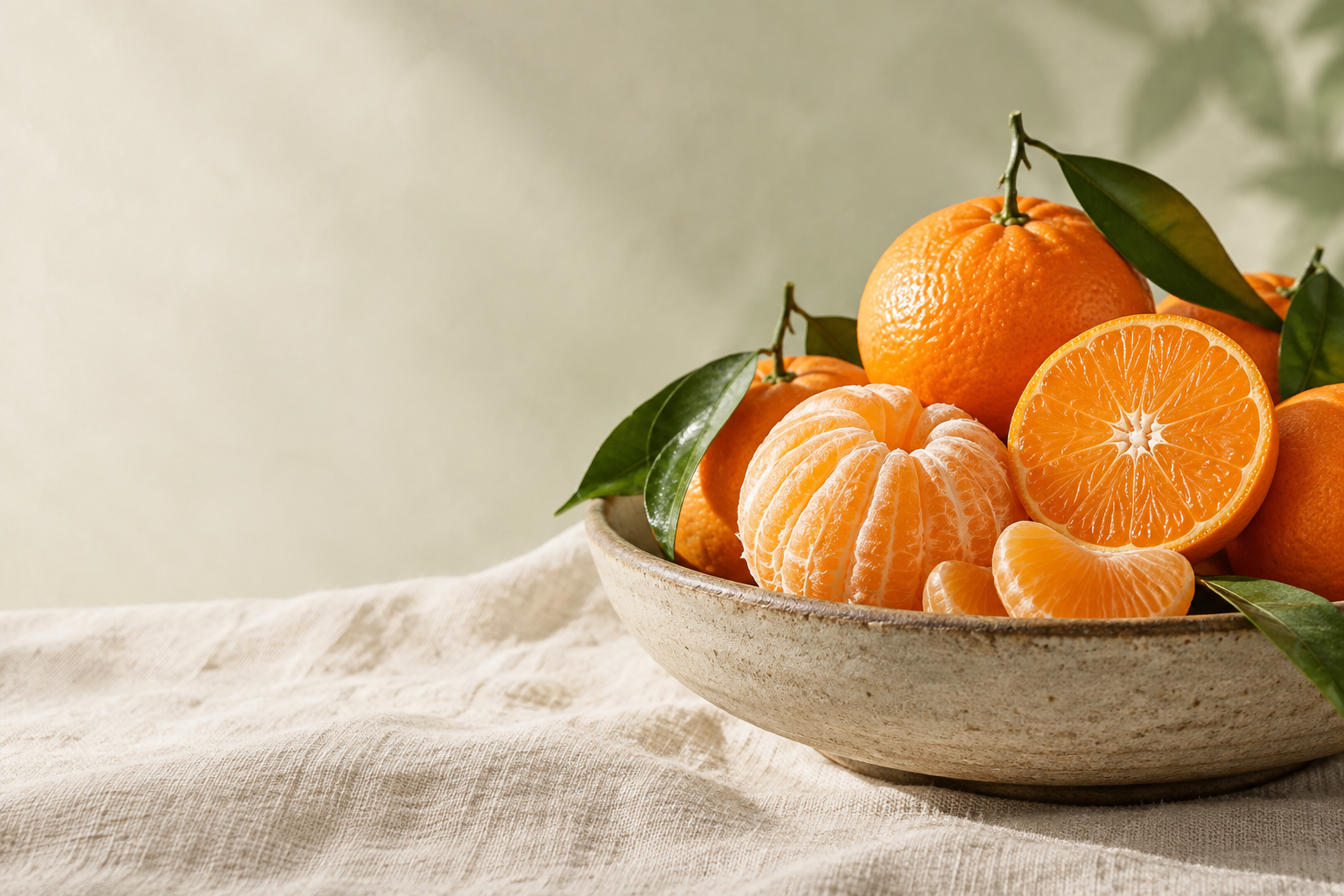
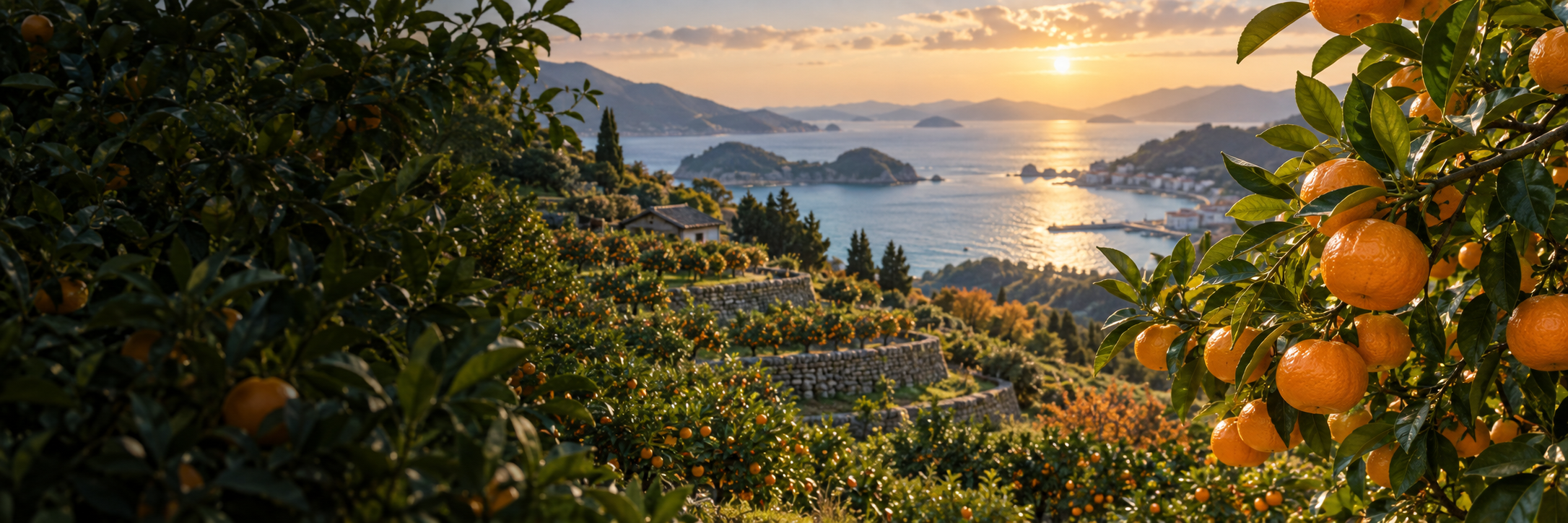 Production area image, AI-generated
ROOTED IN WAKAYAMA
To know mikan is
to know Wakayama.
Light from the sea, mountain slopes, and human hands.
Beyond a small fruit,
lies a landscape that has been passed down.
FIND YOUR MIKAN
Compare representative varieties
Production area, variety, and brand are different things. The differences in names expand the joy of choosing.
| Variety Name | YN26 | Yura Wase | Ueno Wase | Nichinan No. 1 | Miyagawa Wase |
|---|---|---|---|---|---|
| Maturity Classification, etc. | Extra-early (Gokuwase) | Extra-early (Gokuwase) | Extra-early (Gokuwase) | Extra-early (Gokuwase) | Early (Wase) |
| Encyclopedia Points | Quality judgment at the stage when green remains / Distinguishing from Kinoyurara | Discovered 1985, registered 1995 | Confirm the name, classification, and handling within the prefecture | Confirm the name, classification, and handling within the prefecture | Officially recorded as a major cultivated variety nationwide |
made even more delicious.
Choose, peel, savor.
In your everyday mikan,
find a new discovery.
Table of Contents 13 CHAPTERS + 8 PANELS
The mikan you know is one member of a large citrus family
A small mandarin you peel by hand on the kotatsu table. Much of what people casually call “mikan” in everyday conversation is satsuma mandarin 〈unshu mikan〉. That said, the word “mikan” is sometimes used more broadly for citrus relatives as well.04
This encyclopedia first focuses mainly on Unshu mikan. Hassaku, Sanbokan, Jabara, Kinkan, and Shiranuhi are placed on a separate shelf as ‘citrus other than Unshu.’ Even though they are all related, their texture and uses are not the same.0405272930280931323435
Just how much of a ‘mikan prefecture’ is Wakayama?
According to the 2025 crop, First Report from the Ministry of Agriculture, Forestry and Fisheries, Wakayama Prefecture’s mikan harvest came to 145,200 tons. Of the national total of 656,300 tons, this represented 22% of the published share, ranking first among all prefectures.02
When looking at numbers, also check what exactly was counted for the ranking. The results differ between ‘mikan overall’ and ‘ordinary Unshu only.’ This does not contradict Shizuoka Prefecture’s claim of being ‘No. 1 in ordinary Unshu.’ Aligning the item categories clarifies the picture of the numbers.0203
Just remember this: Unshu mikan is one member of the citrus family. Don’t count all citrus as Unshu varieties.
Why can both Wakayama and Shizuoka be ‘No. 1 in Japan’?
In the 2025 crop 1st report, Wakayama ranks first in ‘mikan overall.’ Meanwhile, for ‘ordinary Unshu’ alone, Shizuoka ranks first.0203
What needs attention here is the statistical classification. The crop statistics’ categories of ‘early Unshu’ and ‘ordinary Unshu’ cannot simply be mapped one-to-one onto the four horticultural terms: extra-early, early, medium, and late.
When looking at rankings, always read which crop year, which item/category, and whether it’s harvest volume or shipment volume together as a set. Doing just that clears up a large part of the discrepancies you see in the numbers.02030807
Each mikan name plays its own role
Let’s sort names into six boxes.
| Type of Name | What does it tell you? | Example |
|---|---|---|
| Varieties | What characteristics the fruit inherits | Miyagawa Wase, Yura Wase, YN26, Kyuki, Uemi |
| Lineage | A grouping connected by origin and characteristics | Owari lineage, etc. |
| Maturity Classification | Which group ripens around when | Extra-early, early, medium, late |
| Production Area | Where it was grown | Arida, Shimotsu, Yura, etc. |
| Brand / Certification | Who delivers it under what conditions | Kinoyurara, Arida City-certified mikan, etc. |
| Cultivation / Post-harvest Method | How it is grown and how it is delivered | Greenhouse, mulch, kuradashi (storage-shipped) |
Variety, maturity, production area, brand, and method are separate axes. A single mikan can carry multiple descriptions at once.19060807170911012021
Two pairs of names that are especially easy to confuse
“Arida mikan” and “Arida City–certified mikan” are different things. The former is a name tied to the region and is also registered as a regional collective trademark. The latter is a certification based on a system run by Arida City. It doesn’t mean that every Arida mikan holds the same city certification.1920
“YN26” and “Ki no Yurara”: YN26 is the cultivar name, while Ki no Yurara is the brand name used for fruit from that cultivar that meets certain standards. Finding two names doesn’t mean there are two additional cultivars.0911
Just remember this: ‘Which variety?’ and ‘Which production area?’ are different questions.
Wakayama Mikan, From the Past to Today
Swipe sideways to read. The characters and dialogue are fictional.
Read the text version of the comic
Why Is Wakayama the Land of Mikan?
Has Wakayama mikan been famous since long ago?
Yep! Kishu mikan had already spread widely by the Edo period.
Read the text version of the comic
Old-Time Mikan and Today’s Mikan
Is that Kishu mikan the same as today’s Unshu mikan?
No, they’re different. Unshu mikan spread later on.
Read the text version of the comic
There are orchards even on mountain slopes!
They’ve been growing them on slopes by building stone walls.
The stone-walled terraced orchards of Arida-Shimotsu are one example of that kind of ingenuity.
Read the text version of the comic
Cultivars Have Their Own Seasons Too
Even among Unshu mikan, there are many different cultivars!
Extra-early, early, mid-season, late — they’re grouped by when they ripen.
Read the text version of the comic
From Autumn to Winter, a Change of Leading Role
Are Yura Wase and Miyagawa Wase also cultivar names?
That’s right! In winter there’s also Aoshima Unshu and others. There’s fun to be had choosing by season.
Read the text version of the comic
Growing Region and Cultivar Are Separate Labels
So is ‘Arida mikan’ a cultivar too?
Arida is a growing region. It’s a name for ‘where it was grown.’
Read the text version of the comic
Ingenuity for Delivering Mikan Even Further Into Winter
Is Shimotsu’s ‘kuradashi’ a new cultivar?
It’s a technique of storing before delivering. It’s not a cultivar name.
Read the text version of the comic
Choose Your Next Mikan by Its Name
Growing region, cultivar, season — the text on the bag is starting to get interesting!
When you choose with knowledge, even your usual mikan holds new discoveries.
Season is not a single line, but two tracks: harvest and shipping
When it comes to knowing mikan season, the trick is to separate the time it’s picked from the tree from the time it appears on store shelves.
Wakayama’s outdoor-grown Unshu is generally harvested from September through December. On the other hand, some, like Shimotsu’s kuradashi mikan, are harvested in December, then stored and delivered from January through March. Just because it’s sold after the New Year doesn’t mean it was harvested after the New Year.0817
| Maturity Group | General Guide to Outdoor Harvest Timing | How to View / Enjoy | Example Names |
|---|---|---|---|
| Extra-early (Gokuwase) | Mainly September to October | An early autumn fruit. Even ones with remaining green color should be chosen based on variety and quality | YN26, Ueno Wase, Nichinan No. 1, Yura Wase |
| Early (Wase) | Mainly October to November | The star of late autumn. Even among early varieties, try comparing them by taste | Miyagawa Wase, Okitsu Wase |
| Medium (Nakate) | Late November to around December | A group that bridges into winter. Enjoy not just the sweetness but also the acidity and the texture of the membrane | Mukoyama Unshu, Kyuki |
| Late (Okute) | Mainly December | Also consider the storage and shipping method. Harvest after the New Year is not the defining feature | Hayashi Unshu, Uemi |
The month ranges are a general outline for understanding outdoor cultivation in Wakayama.080717010955065758
Greenhouse cultivation is a separate matter from these four classifications. Growing in facilities allows Unshu to be delivered in seasons different from outdoor cultivation. This does not mean there is a new variety called ‘summer mikan.’08
And the enjoyment of citrus doesn’t end with satsuma mandarins—it continues from winter into spring, and even summer. Since “late-season satsuma mandarin” and “mid-to-late citrus” are not the same term, be sure to look across the full citrus shelf when shopping in spring.3138
Are all green mikan sour?
YN26’s cultivation guide emphasizes harvesting at the right time rather than relying on color alone. Waiting for the peel to turn completely orange does not necessarily benefit quality.10
However, this doesn’t mean the opposite rule — ‘green means ripe’ — is true either. It’s a matter of judging based on variety, timing, and the state of sugar and acid together. At the store, rely on the variety name and the producer’s shipping information rather than color alone.
Citrus has its place in Wakayama summers too
The journey to explore Wakayama’s citrus isn’t limited to winter. A guide from the prefecture’s Nishimuro region introduces Tanabe City and Kamitonda Town as the main production areas, noting that Valencia oranges can also be enjoyed in July.
Rather than lumping all citrus encountered in summer together as ‘summer-picked mikan,’ check the actual name of the fruit. Turning your attention to citrus other than Unshu extends the seasonal calendar a bit further.
References:AS10 ↗
Season Comparison Table
| Category | Harvest Overview | When Checking Sales | Representative Examples |
|---|---|---|---|
| Extra-early (Gokuwase) | Mainly September to October | Check the shipping period. Don’t judge as unripe based on green color alone. | YN26, Ueno Wase, Nichinan No. 1, Yura Wase |
| Early (Wase) | Mainly October to November | Even among early varieties, look at the variety, sorting, and orchard. | Miyagawa Wase, Okitsu Wase |
| Medium (Nakate) | Late November to around December | Unshu transitioning from late autumn to winter. Don’t fix the flavor as uniform. | Mukoyama Unshu, Kyuki |
| Late (Okute) | Mainly December | New Year sales may include stored stock. Harvest after the New Year is not the defining feature. | Hayashi Unshu, Uemi |
| Kuradashi (storage-shipped) / Shimotsu Example | Mainly December | Shipped January to March. A post-harvest process and shipping method. | Not a variety name |
| Greenhouse | Timing shifted from outdoor cultivation depending on the growing method | A method of facility cultivation. Not the same axis as maturity classification. | Not a variety name |
Don’t let Wakayama’s varieties end with just their names
Yura Wase: A single branch that spread the name of a production area
Yura Wase is a bud sport of Miyagawa Wase discovered in Yura Town in 1985. It was registered as a variety in 1995. When you see the name, recall not just the taste but also its background as ‘a fruit connected to a single branch discovered in Yura.’12
YN26: The decision not to wait until it turns orange
YN26 is an extra-early Unshu that can be harvested earlier than Yura Wase. The prefecture’s revised guide indicates an optimal harvest period centered on mid-to-late September. Because harvesting is based on assessing fruit quality, remaining green on the outside alone does not indicate it is unripe.0910
This is exactly why choosing mikan by color alone is difficult: peel color and the sweet-tartness you taste when you bite in don’t necessarily move on the same clock.102021
Kyuki: What was being watched for wasn’t just sweetness
Kyuki is a single-tree mutation of Mukoyama unshu discovered in 2004 in Miyahara-cho, Arida City, and was registered as a mid-season satsuma mandarin in 2014. One of its key traits is having less puffy peel (ukikawa) compared to reference varieties. Cultivar selection matters not just for flavor, but also for handling ease and the quality of the fruit as delivered.09
Uemi: A late variety whose name gives a little joy once you can read it
‘Uemi’ is not a typo. It is a variety selected from a single-tree mutation of Owari-lineage Unshu discovered in Ide, Aridagawa Town in 2006, and registered in 2019. It is introduced as a late variety with less puffy skin compared to Hayashi Unshu and other Owari-lineage varieties.09
Miyagawa Wase, Okitsu Wase, Mukoyama Unshu, Hayashi Unshu
Miyagawa Wase and Okitsu Wase are representative examples of early (wase) varieties. Viewing Mukoyama Unshu as a reference for medium (nakate) and Hayashi Unshu as a reference for late (okute) makes it easier to grasp the flow from autumn to winter. Mukoyama and Hayashi also have product introductions from producers within the prefecture.06075758
Variety is the entry point for understanding a fruit’s character, but the name alone doesn’t determine the entire flavor of that box. Reading the orchard, cultivation, harvest, and sorting together makes the way of choosing more three-dimensional.1316380422312021
What is the ‘nucellar seedling (shushin-hai mishō)’ mentioned in YN26’s origin?
According to Wakayama Prefecture’s origin record, Yura Wase was pollinated with pollen from Benimadoka, and the variety was selected from the resulting ‘nucellar seedling.’ If this is drawn in the same diagram as an ordinary crossbred offspring, a crucial part gets left out.09
The process of “applying pollen” and “which individual grown from which embryo was selected” are two separate pieces of information. Rather than connecting only parent names with arrows, encyclopedic entries record the selection method in words as well: pollination → selection from nucellar seedlings → YN26. When diagramming genetic details, the distinction between nucellar embryos and zygotic embryos should be further cross-checked against specialist references.
It may look like a small note, but it marks a major distinction for not mistaking how the variety came into being.
What’s the difference between ‘bud sport’ and ‘crossbreeding’?
Yura Wase is a bud sport of Miyagawa Wase. Kyuki originates from a single-tree mutation found in Mukoyama Unshu, and Uemi from one found in Owari-lineage Unshu. Haruki, on the other hand, was selected from an individual obtained by crossing Kiyomi and Nakano No. 3 Ponkan.1209
In a variety’s origin, there are two paths: ‘finding and preserving a change that appeared in an existing tree’ and ‘selecting from a crossbred individual.’ This is not about which is superior — it’s a distinction for understanding the accumulation of discovery, observation, and selection.
‘Benimadoka’ and ‘Benimadonna’ are different names
Even when only one character differs, there are cases where names should not be ‘tidied up.’ ‘Benimadoka’ is a pomelo (buntan) variety bred by NARO. ‘Benimadonna,’ on the other hand, is a trademark used for fruits of the variety ‘Ehime Kashi No. 28’ that meet certain standards.
The pollen appearing in YN26’s origin is from ‘Benimadoka.’ Wakayama Prefecture’s materials explain that it was selected from a nucellar seedling obtained through that pollination. If you ‘correct’ it to the more familiar product name, it turns into a different fruit entirely. In citrus names, every last character matters.
Variety and Name Comparison Table
| Name | Name Attribute | Maturity Classification, etc. | Origin | Encyclopedia Points | Relationship with Wakayama |
|---|---|---|---|---|---|
| YN26 | Unshu Variety | Extra-early (Gokuwase) | Selected from a nucellar seedling after pollinating Yura Wase | Quality judgment at the stage when green remains / Distinguishing from Kinoyurara | Bred at the Prefectural Fruit Tree Experiment Station |
| Yura Wase | Unshu Variety | Extra-early (Gokuwase) | Bud sport of Miyagawa Wase | Discovered 1985, registered 1995 | Originated in Yura Town |
| Ueno Wase | Unshu Variety | Extra-early (Gokuwase) | Original historical sources not cross-checked in this survey | Confirm the name, classification, and handling within the prefecture | Handled by producers/sellers within the prefecture |
| Nichinan No. 1 | Unshu Variety | Extra-early (Gokuwase) | Original historical sources not cross-checked in this survey | Confirm the name, classification, and handling within the prefecture | Handled by producers/sellers within the prefecture |
| Miyagawa Wase | Unshu Variety | Early (Wase) | Parent cultivar of Yura Wase | Officially recorded as a major cultivated variety nationwide | Appears in prefectural production-area introductions and the history of Yura Wase |
| Okitsu Wase | Unshu Variety | Early (Wase) | Original historical sources not cross-checked in this survey | Officially recorded as a major cultivated variety nationwide | Appears in the prefecture’s introduction of Unshu |
| Mukoyama Unshu | Unshu Variety | Medium (Nakate) | Parent cultivar of Kyuki | Comparison reference leading into winter | Confirmed as a prefectural product; mutation discovered in Arida |
| Kyuki | Unshu Variety | Medium (Nakate) | A single-tree mutation of Mukoyama Unshu | Less ukikawa (puffy skin) than the comparison cultivar / Registered in 2014 | Discovered in Miyahara-cho, Arida City |
| Hayashi Unshu | Unshu Variety | Late (Okute) | Original historical sources not cross-checked in this survey | Comparison reference for Uemi / Example of a prefectural product | Introduced in shipments by prefectural producers |
| Uemi | Unshu Variety | Late (Okute) | A single-tree mutation of an Owari-lineage Unshu | Less ukikawa than the comparison cultivar / Registered in 2019 | Discovered in Aridagawa Town |
| Aoshima Unshu | Unshu Variety | Supplementary entry for a nationwide cultivar | History and current in-prefecture production to be confirmed separately | Confirmed to exist in 2018 official nationwide acreage data | Current cultivation volume in Wakayama not confirmed |
| Nankan No. 20 | Unshu Variety | Supplementary entry for a nationwide cultivar | History and current in-prefecture production to be confirmed separately | Cultivar confirmed in nationwide research | Current cultivation volume in Wakayama not confirmed |
| Otsu No. 4 | Unshu Variety | Supplementary entry for a nationwide cultivar | History and current in-prefecture production to be confirmed separately | Confirmed to exist in 2018 official nationwide acreage data | Current cultivation volume in Wakayama not confirmed |
| Ishiji | Unshu Variety | Supplementary entry for a nationwide cultivar | History and current in-prefecture production to be confirmed separately | Confirmed to exist in 2018 official nationwide acreage data | Current cultivation volume in Wakayama not confirmed |
| Owari lineage | A name denoting a lineage/strain | Not to be added to the ripening-time table in the same row | Parent lineage of Uemi | Distinguish between a single cultivar name and a lineage grouping | Confirmed in prefectural breeding materials |
| Ki no Yurara | Brand | Related to YN26 | See explanation of trademark use | Not to be counted as two separate cultivars together with YN26 | Confirmed in the prefecture’s trademark guidance |
Differences among production areas are not a ‘sweetness ranking,’ but should be seen through landscape and work
| Production Areas / Regions | Points of Interest in This Encyclopedia | Gateway for a Trip |
|---|---|---|
| Arida City, Aridagawa Town, Yuasa Town, Hirogawa Town | Unshu cultivation, stone-walled terraced orchards, accumulated experience in cultivar selection and sorting | Mikan museum, farm cafés, production-area scenery |
| Shimotsu, Kainan City | Kuradashi (storehouse-aging) techniques including post-harvest storage | Reading kuradashi product descriptions to learn about the production area |
| Around Kinokawa City and Iwade City | A variety of citrus trees besides Unshu, including hassaku | Direct-sale stands, mikan picking |
| Yura Town | The place where Yura Wase was found | The story of its origin and local products |
| Tanabe City and Kamitonda Town | The spread of citrus from Unshu to mid-late-season citrus | Displays and farming experiences in Kamiakizu |
| Kushimoto Town | Kashino kumquats and confections made from them | Food culture that makes use of kumquats |
| Kitayama Village | The history of jabara and processing that makes use of its acidity | Village products and tourist information |
Regional characteristics have been confirmed using materials from local governments, research institutions, and operators.151316381917323312373536
Even within the same town, proximity to the sea, slope orientation, elevation, and soil and water conditions differ. Rather than concluding that “coastal areas always taste this way” or “inland areas are always sweeter,” touring production areas becomes more interesting when you look at what producers do to adapt to each location.131638
Just remember this: a place name isn’t a taste score — it’s a gateway to the background of how the fruit was grown.
Comparing Citrus Other Than Unshu Mikan
| Name | Distinction from Unshu | How to Read the Season | Texture, etc. | How to Enjoy |
|---|---|---|---|---|
| Hassaku | A citrus other than Unshu | Mainly confirmed as available in winter through spring | Firm texture, acidity, slight bitterness | Eating fresh, comparing texture |
| Shiranui | A hybrid cultivar other than Unshu | Winter to spring. Harvest, storage, and sales confirmed separately | Look separately at sweetness, acidity, and how easy the segments are to eat | Eating fresh, comparison with brand names |
| Setoka | A hybrid cultivar other than Unshu | Breeding materials indicate a ripening period around February; sales timing is separate | Thin peel, flesh texture | Eating fresh, enjoying the cultivar’s history |
| Haruki | A prefecturally-bred cultivar other than Unshu | Ripening period is March | Breeding materials describe a crisp texture | Comparison of origin with Shiranui |
| Sanbokan | A citrus other than Unshu | This survey does not fix specific harvest/sales months | Acidity and aroma confirmed per product | Eating fresh and processing; the story behind the name |
| Jabara | A sour/aromatic citrus enjoyed as such | Availability of fresh fruit and processed products confirmed separately | Making use of its strong acidity | Juice, ponzu, beverages |
| Kumquat | A name that includes multiple cultivars | Confirmed per product and cultivar | Processing that makes use of the peel, etc., varies by cultivar and product | Kashino kumquat confections |
| Daidai | A citrus used for its acidity | Uses and regional information confirmed | Using its acidity in cooking | Ponzu use in Nishimuro |
Born in Japan despite being called ‘Unshu’? A detour into name and history
The name “Unshu” derives from a place name in China, but the Unshu mikan as a fruit is said to have originated in Japan. In an interview with a researcher featured by the Ministry of Agriculture, Forestry and Fisheries, an explanation stating it originated on Nagashima Island in Kagoshima Prefecture is introduced.0405
Meanwhile, DNA-based research by NARO (National Agriculture and Food Research Organization) estimates that the seed parent of Unshu was Kishu mikan and the pollen parent was Kunenbo. This is research examining parent-offspring relationships, and it does not directly prove the place or era of origin.05
Wakayama’s Long History and the History of Today’s Cultivars Are Separate Matters
Kishu mikan, which spread during the Edo period, and Unshu mikan, which became widespread afterward. When reading the history of the production area, keeping these two separate avoids confusion. “Over 400 years of mikan growing” and “Yura Wase was found in 1985” are both true at the same time.12041354
The Stone-Walled Landscape Becomes a Globally Important Agricultural Heritage System
In the Arida-Shimotsu region, farmers have built stone terraces on sloped land, selected cultivars and cultivation methods suited to each site, and refined storage and shipping methods over time. In August 2025, this system was recognized by the FAO as a Globally Important Agricultural Heritage System (GIAHS) under the name “Arida and Shimotsu’s Stone-Walled Terraced Mikan Farming System.”1354141516
The appeal isn’t just that old stone walls remain. It’s that they remain connected to the ongoing work of growing and delivering fruit today. Note that GIAHS is a separate system from UNESCO World Heritage Sites.1314
If We Know Unshu’s Parents, Do We Know Where It Was Born?
NARO used DNA markers to estimate that Unshu’s parents were Kishu mikan and Kunenbo. What the research answered was the genetic parent-offspring relationship.05
On the other hand, questions of “when, where it was born, and how it spread” also require historical documents and cultivation records. The official explanation that it originated on Nagashima Island in Kagoshima Prefecture is introduced as that kind of historical account.0405
A map of genetics and a map of history carried by people. Overlaying the two makes things more interesting, but one does not fully prove the other.
Comparison Table of Production Areas
| Region | Area/Scope | Confirmed Differences | What Not to Assert as Absolute |
|---|---|---|---|
| Arida | Arida City, Aridagawa Town, Yuasa Town, Hirogawa Town | Stone-walled terraced orchards / Unshu cultivation / sorting and certification systems | Not all fruit has the same sugar content, and not all products are city-certified |
| Shimotsu | Shimotsu, Kainan City | Kuradashi, including post-harvest storage and shipping | Kuradashi is not a cultivar |
| Kinokawa / Iwade | Naga region | Diverse fruit trees including Unshu and hassaku | Not asserting that inland areas are always sweeter |
| Yura | Yura Town in the Hidaka region | Origin of Yura Wase | Whether the original tree can be freely visited is unconfirmed |
| Tanabe / Kamitonda | Nishimuro region | From Unshu to diverse mid-late-season citrus | Not asserting that every orchard offers every cultivar |
| Kushimoto | Kushimoto Town, Kashino, etc. | Kumquats and the food culture that uses them | Current shops selling the soft-serve are unidentified |
| Kitayama | Kitayama Village | History of jabara and uses that make use of its acidity | No claims of efficacy such as hay fever relief are made |
Before a single fruit, there is a year’s worth of work
Pruning from winter to spring, flowers in spring, fruit set in early summer, thinning in summer, harvest from autumn to winter. Mikan trees are not cared for only during the fruiting season.0825
Reducing the Fruit Is Also Part of the Growing Work
More fruit is not necessarily better. Thinning adjusts the balance between the fruit left on the tree and the burden on the tree. Mikan trees have a tendency called “alternate bearing,” where fruiting varies significantly from year to year, so management must also look ahead to the following year.25
The White Sheet on the Ground Creates an Environment for the Fruit
Mulch cultivation covers the ground with a sheet to adjust moisture and light conditions. Wakayama’s production-area materials also introduce cultivation using moisture-permeable mulch. The story of building sweetness is connected not only to sunlight but also to how water is managed.0838
However, it cannot be simplified to “the drier, the sweeter.” This is management aimed at maintaining fruit quality while protecting the tree. Also, “mulch” is the name of a cultivation technique, not a label meaning pesticide-free or organic.101608
Cultivar Improvement Also Works in Ways Eaters Don’t See
“Ukikawa” (puffy skin) is a condition where a gap forms between the peel and the flesh. In the breeding of Kyuki and Uemi, having less of this ukikawa is valued. Ease of transport, appearance, and condition until eaten — a cultivar’s character also includes these practical advantages.0910
Is Ukikawa, Where the Peel Puffs Up Loosely, Related to Cultivar Improvement?
Ukikawa is a disorder in which a gap forms between the peel and the flesh. Being easy to peel and being in a condition suited for transport and storage are not the same thing.0910
In Kyuki and Uemi, having less ukikawa than the comparison cultivar is reported as a characteristic. Cultivar improvement is not just a competition to raise sugar content; it’s work that also includes how the tree grows and how easy the fruit is to handle.09
Why Does a Year with Many Mikan Tend to Be Followed by a Year with Fewer?
Unshu has a tendency called “alternate bearing,” where years with heavy fruiting and years with light fruiting tend to alternate. Setting fruit, growing the tree, and preparing for the following year — thinning and other practices are done to balance these.25
The interesting thing about farming is that it doesn’t work as “there’s a lot of fruit this year, so let’s leave it all.” Behind a single fruit lies a decision that considers not just this year but next year too.
How Do You Propagate Mikan That Have Few Seeds?
You won’t necessarily find seeds every time you eat a mikan. Yet orchards can still increase their trees because there are methods other than sowing seeds. In cultivation, buds or branches of the cultivar you want to grow are grafted onto rootstock, such as trifoliate orange, to produce seedlings.
Even if you grow a seed you happened to find, it won’t necessarily produce the same fruit you ate. It becomes easier to understand if you think of “discovering a new cultivar” and “propagating that cultivar” as separate matters.
References:AS01 ↗
Is Warmer Always Better for Mikan?
A warm climate is an important clue for understanding a production area. However, it cannot be said that the warmer, the better. Research has shown that in Unshu mikan, ukikawa, where the peel separates significantly from the flesh, tends to occur more easily at high temperatures.
Ukikawa isn’t just a cosmetic problem. It makes the peel more prone to damage and affects quality during transport and storage. In research in which Wakayama Prefecture also participated, techniques to mitigate this problem were examined. The work of delivering each fruit in good condition continues into adapting to a changing climate.
References:AS11 ↗
The taste of mikan cannot be fully told by sugar content alone
“I prefer higher sugar content.” That’s one way to choose. But even with the same number, if the acidity, aroma, juiciness, and mouthfeel of the segment membrane differ, the impression when eating changes.042231
A Refractometer Reading Isn’t the Whole Report Card for a Fruit
Brix, commonly used for fruit juice, is an index based on a sucrose solution as its standard. Because juice also contains dissolved components other than sugar, a Brix of 12 does not necessarily mean “12g of sugar per 100g of juice.”22
The numbers at the point of sale become useful once you read the conditions behind them: Is it a value measured piece by piece? An average of sampled fruit? A description of the whole product? Even with the same “12 degrees or higher,” check the measurement method and what it’s based on.2320
What Happens While the Fruit Waits in Storage?
In kuradashi, the fruit’s condition is managed after harvest before shipping. As acid decreases, sweetness can become easier to perceive. On the other hand, the explanation that sugar keeps being produced simply by leaving the fruit alone is not accurate.172422
A reading getting more concentrated due to changes in moisture content is different from the amount of sugar in the fruit itself actually increasing. If you separate “the flavor becomes mellower” from “the sugar increases,” the topic of storage becomes far more interesting.2422
Selecting with Light, Without Peeling
There is also technology that estimates sugar and acid from light information without cutting the fruit. Wakayama’s Saika Technical Research Institute also introduces technology in this field. Sorting includes efforts to more reliably deliver information about the inside that cannot be known just by looking from the outside.23
Does a Brix of 12 Mean 12% Sugar?
For a pure sucrose solution, the definition of Brix corresponds directly to the mass percentage of sucrose. However, fruit juice is a mixture that also contains components other than sugar. Care should be taken not to directly read a value obtained using refraction, etc., as the “sugar-only content ratio.”22
This doesn’t mean the measure is useless for choosing mikan. It’s precisely because it’s such a convenient benchmark that you should know what the number is actually measuring before using it. That’s one step beyond simply ranking fruit by sugar content alone.
Does It Get Sweeter in Storage Because Sugar Increases?
During storage, acid decreases, and sweetness can become easier to perceive. A published abstract of research storing Unshu at 5°C and 15°C reports that the amount of sugar per fruit remained largely unchanged while acid decreased.1724
On the other hand, since Brix is an index related to concentration, changes in moisture also need to be considered separately. The observation that “sugar content rose” is not synonymous with “the total amount of sugar increased.”2224
This single study does not determine outcomes for every cultivar and storage condition. This encyclopedia explains mellowness, acidity, concentration, and the total amount within the fruit separately. It is not used as a basis for deciding home storage periods.
How Does an Optical Sensor “See” Inside the Peel?
There is technology that estimates values related to sugar and acid from information in light applied to the fruit. The Saika Technical Research Institute’s explanation also describes the importance of non-destructive measurement and calibration curves/calibration.23
Behind the convenience of selecting fruit without peeling it lies work verifying the relationship of “if the light has this characteristic, the inside is likely at this level.” Rather than the machine fully understanding the fruit’s deliciousness, it’s easier to understand as a tool for increasing the number of checked items and delivering fruit more consistently.
How to read grade, size, and brand
Viewing Size and Deliciousness Separately
S, M, and L are size indications. For example, according to Sowa Orchard’s explanation, S is 5.5–6.1cm in diameter, M is 6.1–6.7cm, and L is 6.7–7.3cm. What is shown here is only an example from that company’s chart.21
Whether you enjoy a small one many times or take your time with a larger one — size can be chosen based on preferences like these. There’s no need to judge by size alone, such as assuming “small ones are always sweet” or “large ones taste weaker.”102021
The Meaning of “Shu” (Premium Grade) Isn’t Always the Same
Aka-shu and Ao-shu, as explained by Sowa Orchard, are examples of that company’s appearance-based sorting. They are not necessarily selected using the same criteria or boundaries as “Shu” or “Yu” grades used by other shipping organizations.2021
For gifts, appearance and packaging become useful conditions. For eating at home, there’s also the option of prioritizing ripeness and quantity over appearance. Once you understand what the standard means, it becomes easier to make sense of price differences.082021
If You’re Unsure About a Brand, Read These Three Points
What is the cultivar? Where is the production area? What kind of sorting and certification is used?
Arida City-certified mikan combine conditions such as an average sugar content of 12 degrees or higher and acidity of 1.0% or less in sampled inspections, with sensory evaluation. This is a label meant to be understood by reading what the Arida City system actually verifies.20
“Ajikoi” is a brand/product name of Sowa Orchard. It is a different name from “Aji-ichi Premium” and others. Even with similarly-sounding names, don’t lump them together — read each seller’s explanation individually.5659
Is a Brand’s “12 Degrees or Higher” Guaranteed for Every Single Fruit?
For example, in the Arida City-certified mikan system, conditions such as an average sugar content of 12 degrees or higher and acidity of 1.0% or less in sampled inspections are confirmed, and sensory evaluation is also conducted.20
This is a system that uses the average of sampled inspection subjects. It cannot be stated that “every single fruit in a certified box definitely has the same sugar content.” On the other hand, even when another shipping organization passes each individual fruit through an optical sensor, the inspection items and judgment methods need to be checked individually.23
Standards exist not to make you doubt a brand, but to help you understand it correctly and choose accordingly.
“Ki no Yurara” Has Conditions for Using the Name
“YN26” and “Ki no Yurara” are not two different cultivars. YN26 is the cultivar name, and Ki no Yurara is the trademark used for its fruit. According to Wakayama Prefecture’s guidance, meeting certain quality standards is required.
The procedures guided by the prefecture for producers who sell without going through JA also have rules for application and quality control. Being the same cultivar doesn’t automatically mean every fruit becomes the same brand.
Reading Labels and Standards
| Label | Classification | Meaning | What Not to Confuse | Source URL |
|---|---|---|---|---|
| Arida Mikan | Regional name + Regional collective trademark | A name indicating a product of the Arida region | Not synonymous with a single cultivar or with Arida City certification | https://www.jpo.go.jp/system/trademark/gaiyo/chidan/shoukai/ichiran/5002567.html |
| Arida City-Certified Mikan | City certification system | Average sugar content of 12+ and acidity of 1.0% or less, etc., in sampled inspection, plus sensory evaluation | Not all Arida-grown fruit, and not every single fruit at 12 degrees or higher | https://www.city.arida.lg.jp/sangyoshigoto/gensanchi/1002053/1001170.html |
| Ki no Yurara | Brand/Trademark | YN26 fruit that meets the standard | Not a different cultivar from YN26 / Numerical standards not finalized (in this survey) | https://www.pref.wakayama.lg.jp/prefg/070300/d00153085.html |
| Dekopon | Brand/Trademark | Shiranui’s quality and conditions for brand use | Not another name for all Shiranui | https://ja-kamoto.or.jp/product/%E3%83%87%E3%82%B3%E3%83%9D%E3%83%B3/ https://www.ja-kumamoto.or.jp/wp/news/agribito/2025/01/37243 |
| Ajikoi | A producer/seller’s brand | Sowa Orchard’s product name | Not the same as Aji-ichi / Not a cultivar name | https://sowakajuen.com/c/seasonal-mikan/winter-mikan/mikan-ajikoi |
| Aji-ichi Premium, Aji-ichi Kiwami | Shipping brand | Market handling confirmed | Not all current thresholds finalized in this pack | https://www.tokyo-seika.co.jp/251128-2/ |
| S, M, L | Size | Example: Sowa S 5.5–6.1cm, M 6.1–6.7cm, L 6.7–7.3cm | Not a nationwide uniform standard or a ranking of taste | https://sowakajuen.com/articles/citrus-dictionary/how-many-can-fit-in-one-size-box-of-mandarin-oranges/ |
| Aka-shu, Ao-shu | Example grade varying by producer | According to Sowa’s explanation, appearance-based sorting | Do not simply compare with the ‘shu’ (excellent) and ‘yu’ (superior) grades used by other organizations. | https://sowakajuen.com/articles/citrus-dictionary/how-many-can-fit-in-one-size-box-of-mandarin-oranges/ |
| Brix | Quality indicator | A measurement index based on sucrose solution as the reference standard | It does not correspond exactly to the sugar content ratio in the juice alone. | https://www.mt.com/jp/ja/home/perm-lp/product-organizations/ana/brix-meters.html |
| Mulch | Cultivation method | A management practice of covering the soil surface with sheeting | It is not synonymous with organic or pesticide-free. | https://www.pref.wakayama.lg.jp/prefg/071700/kokunai/brandshien/R2/d00205865.html https://www.pref.wakayama.lg.jp/prefg/130600/130651/sanchi/mikan/w43.html |
| Kuradashi | Post-harvest management and shipping | Stored and conditioned before being delivered | Not a cultivar name, and not the same as leaving fruit at home for a long time | https://www.pref.wakayama.lg.jp/prefg/130100/shokuzai-kaisou/kuradashi_mikan.html |
How to choose one fruit that suits you today
| Ways you might want to enjoy it | What to check when buying |
|---|---|
| Want to enjoy the first mikan of autumn | Look at the extra-early cultivar name, growing region, and shipping period — don’t judge by color alone |
| Want to eat with family in winter | The amount you can finish at once, the size, and the condition on arrival |
| Want to enjoy the acidity too | Not just the Brix number, but the description of acidity as well, and, if you can taste-test, your actual preference |
| Want to give it as a gift | Cultivar and growing region, the definition of the grade, packaging, and an amount the recipient can finish |
| Want to know the difference | Compare two types under matched conditions, and note whether the difference comes from the cultivar or from the sorting/grading |
This is not a table for ranking, but a suggestion of criteria for choosing.102021080431
Also check that the peel has no damage or mold, and that the fruit isn’t crushed. To avoid the disappointment of ‘I bought a great brand, but ended up with too much to eat,’ pacing your consumption matters just as much as your taste preference.084140
Enjoy a box of mikan comfortably to the very last one
Once it arrives, open the box right away
Inspect inside the box and separate out any crushed or damaged fruit. Check the bottom layer too, being careful not to bruise the fruit. Don’t leave a tightly packed box sitting in a warm room — arrange a proper storage spot and condition.0841
A cool, dark winter storage spot is different from a heated room
In a cool, well-ventilated spot in winter, store the fruit away from direct sunlight and heating. During hot weather, or when you can’t secure a cool spot, use somewhere like a vegetable crisper drawer, while also watching out for dryness or excess moisture. Think in terms of the actual temperature and conditions of where you’re placing it, rather than the season’s name.0840
The long-term storage carried out in kuradashi mikan-producing regions is a technique for managing the environment and the fruit itself. It does not mean it’s fine to leave a box at home untouched for months.1740
The white strings don’t need to be removed — they’re edible
The white strings on a mikan are vascular bundles that carry water and nutrients to the fruit. They’re edible, so it’s fine to leave them on if you prefer. The texture of the segment membrane is also part of the fun of comparing citrus.260431
Putting them on one plate makes the differences easier to see
Line up two types at the same temperature and jot down notes on sweetness, acidity, aroma, juiciness, and membrane texture. Rather than assigning scores, noting ‘when I’d want to eat this next’ turns it into your own personal mikan encyclopedia.0431
Beyond Unshu, the world of citrus continues
Shiranui and Dekopon: Two Names That Don’t Mean the Same Thing
Shiranui (written as ‘shiranuhi’ in NARO’s notation) is a cultivar whose parents are Kiyomi and Nakano No. 3 ponkan. Dekopon is a brand name associated with this fruit. Beyond conditions such as a Brix of 13 degrees or higher and an acidity of 1.0% or lower, there are also rules governing use of the name.272930
The bump on top catches the eye, but appearance alone doesn’t determine the brand or the taste.
Setoka: Looks Like a Relative of Unshu, But Has a Different Lineage
Setoka’s parents are (Kiyomi × Encore No. 2) and Murcott. It’s a hybrid cultivar we’d like to introduce separately from the list of Unshu cultivars. Viewing it as a citrus to enjoy for its thin peel and flesh texture widens your options at the store.28
Haruki: Same Parent Combination as Shiranui, But a Different Fruit
Haruki, bred by Wakayama Prefecture, also has Kiyomi and Nakano No. 3 ponkan as parents. It ripens in March and is described as having a crisp texture. Different personalities can emerge from the same parent combination — that’s the kind of discovery a citrus family tree offers.09
Hassaku: Prized for the Bite of Each Segment More Than Its Juice
Hassaku’s appeal lies in its firm-textured flesh, tartness, and slight bitterness. Rather than lumping it together with juicy citrus as ‘big and full of juice,’ it’s a fruit best enjoyed for the feel of biting into a single segment. In Wakayama, this leads into introductions of growing areas such as around the Kinokawa River.323331
Sanbokan: Behind the Name, an Old Wakayama Story
According to Yuasa Town, there’s a tradition that the name Sanbokan comes from the fruit being presented as a gift placed on a sanbo (a traditional offering stand). It’s an entry point for savoring a local story, somewhat different from a modern cultivar comparison.34
Jabara: Making the Most of Its Sourness, Not Its Sweetness
Jabara from Kitayama Village is a citrus best appreciated for uses that make the most of its sourness, such as juice, ponzu, and beverages. Rather than judging it by ‘how sweet it is’ the way you would Unshu, keeping an open mind widens the ways it can pair with cooking.3536
Kumquat: Turned Into a Kushimoto Confection That Showcases the Fruit
Gihei in Kushimoto makes ‘Washi no Shorasan,’ using kumquats from Kashino. It’s a confection combining ogura yokan (sweet bean jelly) and murasame (a steamed cake), showing how the fruit is transformed into a local sweet.37
Reading Up on the Cultivar and Method Makes Juice Interesting Too
Sowa Fruit Farm describes a juicing method that removes the peel but includes the inner membrane. The processing method, the fruit used, and the juice labeling are each separate pieces of information. In a form different from fresh fruit, you can still taste the region’s ingenuity.39
The use of daidai (bitter orange) for ponzu, as introduced in Nishimuro, is another part of the food culture that brings sourness into cooking.38
As ideas from our editorial team for ways to enjoy it, you might try adding satsuma mandarin segments to a salad, mixing a small amount of the juice into a dressing, or serving it alongside yogurt. These aren’t introductions to traditional dishes or tested recipes, but simply suggestions for expanding enjoyment at home.
Shiranui and Haruki have the same parent combination, yet they’re different cultivars?
Both have Kiyomi and Nakano No. 3 ponkan as parents. However, the individual tree from which Shiranui was bred and the individual selected as Haruki are different. Even when the parent names match, that doesn’t mean the cultivars are identical.2709
When looking at a citrus family tree, distinguishing between ‘parent combination’ and ‘selected individual’ conveys the fascination of fruits that are similar yet different. The explanation here is a comparison of lineage, not the result of tasting or analyzing both cultivars under the same conditions.
What Does ‘Reconstituted’ in Juice Actually Restore?
When choosing mikan juice, look not only at the fruit’s growing region but also at the labeling of the production method. ‘Straight’ (not-from-concentrate) means the squeezed juice is used without concentrating it. ‘Reconstituted from concentrate’ means juice that was once concentrated has water added back to restore it to its original strength.
These are terms for understanding a difference in production method. Don’t decide a juice is ‘watered-down’ just because it’s labeled ‘reconstituted from concentrate,’ or assume ‘straight’ means ‘unheated’ — check the ingredients and product description together as well.
References:AS08 ↗
Whole Mikan in a Can, Not Separated into Segments
Canned mikan aren’t limited to segments — some let you enjoy the fruit whole. Kishu Foods of Wakayama offers a canned product made with whole prefecture-grown Unshu mikan, with straight mikan juice added to the syrup as well.
According to the company, it’s produced using their own low-temperature pasteurization equipment. How the fruit is processed and in what form it’s delivered — the region’s ingenuity can be found in places other than fresh fruit as well.
References:AS09 ↗
After learning, visit the production area
Beyond just mikan picking, you can learn the history, view exhibits, taste at a farm cafe, or look for names at a direct-sales stand. Deciding on one purpose makes it easier to plan your trip.
| Destination | Area | Suggested way to enjoy |
|---|---|---|
| Arida City Mikan Museum | Minoshima, Arida City | Learn the history of cultivation and distribution before touring the growing area |
| Cafe Mikan no Ki, Arida Main Store | Arida City | Enjoy Ito Farm’s citrus at the cafe |
| M.CITRUS FRUIT PARLOR | Suhara, Yuasa Town | Encounter food and drinks made with fruit from Nushii Farm |
| Kannonyama Fruit Garden | Kinokawa City | Experience mikan picking in the orchard |
| Mekkemon Hiroba | Toyota, Kinokawa City | Choose by checking the cultivar and producer labels at the direct-sales stand |
| Akizuno Garten / Mikan Classroom Karatachi | Kamiakizu, Tanabe City | Experience exhibits in the former school building and rural life |
| Gihei | Kushimoto Town | Learn about food culture through confections made with Kashino kumquats |
| Kitayama Village’s Jabara / Tourist Information | Kitayama Village | Trace the village’s products and the history of jabara |
These are candidates whose information was verified through official sources from the facilities, stores, and municipalities. This is not a firsthand account of an on-site visit.35363742434445534647484964
One Theme per Area
In Arida-Yuasa, one approach is to learn the background at a museum before heading to a farm café. In Kinokawa, you could combine a direct-sales stand with mikan picking. In Tanabe-Kamiakizu, you might view an exhibition first, then consult about a farming experience suited to the season.42434445534647484964
Don’t think of Kushimoto or Kitayama as being ‘right nearby’ all of these places — treat them as a separate day or a separate trip theme. When spreading out the map, the trick is to decide first what you want to savor that day, rather than adding more destinations.4245463537
Farms and the stone-walled terraced orchards are also workplaces for the people who tend them. The scenery visible from the road is separate from orchards you’re allowed to enter. Follow the guidance and instructions of the managers for viewing and photography, and choose gear suited to the slopes and footing for harvest experiences.
Go meet your next mikan.
About the Main Information Sources and Published Content
Article verification date: September 24, 2026. Harvest and shipping months are approximate. Business hours, prices, and product stock are subject to change, so please check each official source before heading out. The comic is a work of fiction and does not reproduce interviews with real individuals. AI-generated images are not used as evidentiary photos of actual growing regions or specific cultivars.
- Online Resort | Wakayama Mikan Encyclopedia: We Lined Up Nearly Every Cultivar
- Ministry of Agriculture, Forestry and Fisheries | Reiwa 7 (2025) Mikan Fruit-Bearing Area, Harvest Volume, and Shipment Volume (Report 1)
- Shizuoka Prefecture | No. 1 in Japan for Ordinary Unshu Mikan Production
- Ministry of Agriculture, Forestry and Fisheries | Feature 1: Mikan (1)
- NARO | Estimating Parent-Child Relationships of Citrus Cultivars Using SNPs
- NARO | Unshu Mikan Cultivars and Cultivation Area
- NARO | Research Results on the Unshu Mikan Cultivar Group
- Wakayama Prefecture | Wakayama Food Terroir – Unshu Mikan
- Wakayama Prefectural Fruit Tree Experiment Station | Cultivars in the Spotlight
- Wakayama Prefectural Fruit Tree Experiment Station | Cultivar Characteristics and Cultivation Notes for the New Unshu Mikan Cultivar YN26
- Wakayama Prefecture | About Trademark Use of Ki no Yurara
- Ministry of Agriculture, Forestry and Fisheries, Kinki Regional Agricultural Administration Office | Yura Town: The Mother Tree and Place of Origin of Yura Wase
- Ministry of Agriculture, Forestry and Fisheries | The Stone-Walled Terraced Mikan Orchard System of the Arida-Shimotsu Region
- Wakayama Prefecture | Globally Important Agricultural Heritage Systems Designation
- Hirogawa Town | The Mikan Agricultural Heritage of Arida-Shimotsu
- Ministry of Agriculture, Forestry and Fisheries | Feature 1: Mikan (2) Cultivation in Growing Regions
- Wakayama Prefecture Kaiso Promotion Bureau | Shimotsu Mikan (Kuradashi Mikan)
- JA Wakayama | Introduction to Agricultural Products
- Japan Patent Office | Arida Mikan Regional Collective Trademark, Registration No. 5002567
- Arida City | Arida City-Certified Mikan
- Sowa Fruit Farm | Mikan Size, Grade, and Box Count
- Mettler-Toledo | The Principle of the Brix Meter and the Meaning of Brix
- Saika Technical Research Institute | The Principle and Technology of Sugar-Acidity Meters
- Izumi Hidemi, Ito Takuji, Yoshida Yasuharu / Journal of the Japanese Society for Horticultural Science | Changes in Quality During Storage of Unshu Mikan Fruit by Fruiting Position in the Inner and Outer Canopy
- Ministry of Agriculture, Forestry and Fisheries | Years When Mikan Bear Heavily and Years When They Don’t
- Ministry of Agriculture, Forestry and Fisheries | What Are the White Strings on a Mikan?
- NARO | Shiranui
- NARO | Setoka
- JA Kamoto | Introduction to Dekopon
- JA Group Kumamoto | The Dekopon Brand and Trademark
- Ministry of Agriculture, Forestry and Fisheries | Feature 1: Mikan (4) Various Citrus
- Wakayama Prefecture | Wakayama Food Terroir – Hassaku
- Wakayama Prefecture Naga Promotion Bureau | Agriculture in the Naga Region
- Yuasa Town | Sanbokan
- Kitayama Village | Jabara
- Kitayama Village | The History of Jabara
- Gihei | Washi no Shorasan
- Wakayama Prefecture Nishimuro Promotion Bureau | Mikan of the Nishimuro Region
- Sowa Fruit Farm | Processing Methods for Juice Products
- JA Kochi Prefecture | How to Choose and Store Unshu Mikan
- USDA FSIS|Molds on Food: Are They Dangerous?
- Arida City | Arida City Mikan Museum
- Ito Farm | Cafe Mikan no Ki
- Nushii Farm | M.CITRUS FRUIT PARLOR
- Kannonyama Fruit Garden | Kannonyama Fruit Garden Mikan Picking
- Akizuno Garten | Akizuno Garten Guide
- Akizuno Garten | Mikan Classroom Karatachi
- Akizuno Garten | Farm Experience & Orchard
- Wakayama Prefecture | Mekkemon Hiroba
- Wakayama Prefecture Official Tourism Site | Prefectural Tourism Photo Library
- Arida-Shimotsu Regional Globally Important Agricultural Heritage Systems Promotion Council | About Logo Mark Usage
- Adventure World | THANKS PANDA FAMILY
- Wakayama Prefecture Official Tourism Site | Kannonyama Fruit Garden – Tourist Information
- Globally Important Agricultural Heritage Systems Promotion Council | Explanation of the Arida-Shimotsu Stone-Walled Terraced Mikan Orchard System
- Sowa Fruit Farm | Product Introduction of Extra-Early Mikan
- Sowa Fruit Farm | Ajikoi Mikan
- Premier Wakayama | Unshu Mikan Mukoyama
- Premier Wakayama | Unshu Mikan Hayashi
- Tokyo Seika | Market Introduction of Ajiichi Premium and Ajiichi Kiwami
- Toa Seika | Introduction of Shunpo Arrivals
- Arida Mikan Regional Site | Unshu Mikan Season and Cultivars
- Wakayama Prefecture Official Tourism Site | Tourism Site Terms of Use
- Ministry of Agriculture, Forestry and Fisheries | Agriculture, Forestry and Fisheries Statistics – Fruit Tree Production and Shipment Statistics
- JA Wakayama | JA Wakayama Official