

WAKAYAMA · THE KUROE ATLAS
Kishu Lacquerware and the Tools of Kuroe
Choose a vessel. Bring a little of its home into yours.
Contents 8 CHAPTERS + 1 STORY
After discovering Wakayama’s food, look at the vessels that hold it. This guide starts in Kuroe, Kainan, and separates place names, materials, use and care. The most expensive piece is not necessarily the best fit for your table.
Look beyond the colour.
Swipe horizontally to read, or use the left and right arrow keys.
A journey that begins in Kuroe
Kainan City identifies Kuroe, in its northwestern area, as a centre of Kishu lacquerware production. Its origins are said to date to the Muromachi period, and the industry developed during the Edo period. Origin stories include tradition rather than a single settled account. Kishu lacquerware received national traditional-craft designation in 1978. A long history does not, by itself, tell you the specifications of a particular product.
A place name does not specify the material
The cooperative’s process guide describes both wooden and resin products: forming the base, preparing the surface, coating and decoration. Do not assume that every item from the region is natural wood coated with urushi lacquer. Check the substrate, coating, intended use and precautions on the individual product. Material differences help you choose for your routine, not rank every item on one ladder of quality.
Reading the red and black of Negoro
The cooperative describes Negoro lacquer as red over a black undercoat, with black showing through as the surface wears. Its appeal invites you to see a vessel over time. That does not mean every pattern on a modern product resulted from natural wear. Ask how a particular piece was finished; do not infer its manufacture from a historical account.
At a glance: four questions before buying
Before buying, check four things: substrate, coating, use and care. A product name or appearance cannot establish microwave or dishwasher compatibility. For a gift, consider how the recipient washes and stores their tableware. Prices depend on the shop and product; this guide does not invent a universal price range.
| Check | Look for | Do not assume |
|---|---|---|
| Substrate | Wood, resin or other material | A place name fixes the material |
| Coating | Urushi or other finish | Colour identifies the coating |
| Use | Purpose and compatibility | All items are microwave-safe |
| Care | Instructions and repair advice | One method suits everything |
Choose a shape for the way you live
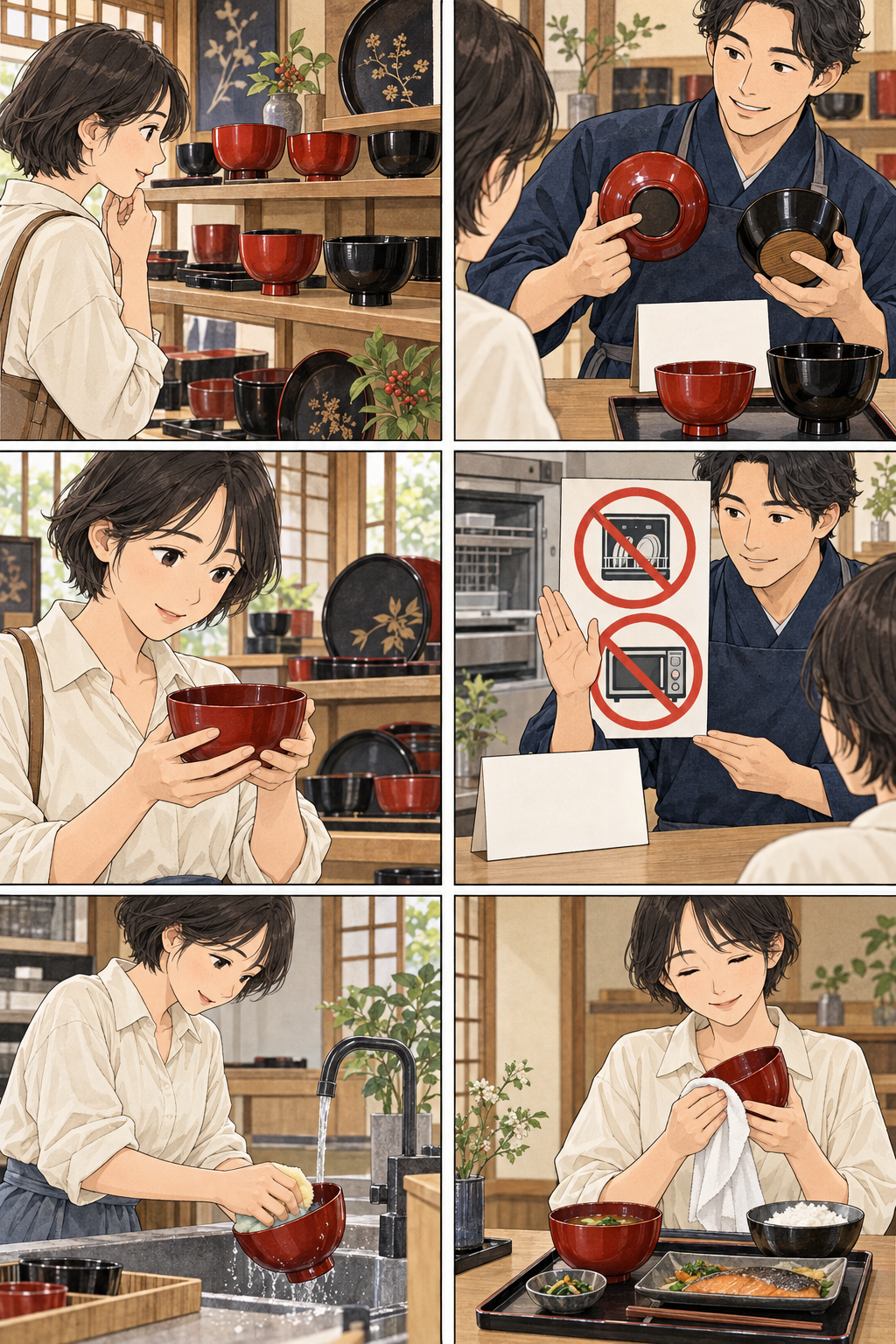
For a soup bowl, consider how it sits in the hand, the rim and your usual serving size. For a tray, start with what it will carry and where you will store it. For a tiered box, decide whether it is for special occasions or everyday meals. These are editorial selection tips, not performance guarantees. Ask permission before handling items in a shop and follow the seller’s guidance.
Start with the product’s care instructions
Kuroeya’s care guide recommends avoiding prolonged soaking, washing with a soft cloth or sponge and wiping dry. It warns about direct sunlight, direct heat, microwaves and dishwashing or drying machines, while distinguishing products explicitly marked as compatible. The instructions for your own product take priority. If they are unclear, ask the seller before use. Discuss repair options before sanding or attempting to fix damaged coatings yourself.
Walk the town, discover the work
Kainan’s walking guide describes Kuroe’s sawtooth streetscape around Kawabata-dori and its lanes. This is a living and working neighbourhood, not just a display. Stay out of private areas and ask permission to photograph people, shop interiors or work. The Kishu Lacquerware Traditional Industry Hall offers displays, sales and explanations of production; the city also describes reservation-based maki-e experiences. Kuroe Nurimono-kan appears in the city’s visitor information too. Check current opening and booking conditions before travelling.
Common questions
Is everything natural wood and urushi? The place name alone cannot tell you. Can it go in the dishwasher? Read compatibility markings and the instructions. Did every Negoro pattern develop through use? Ask about the finish. Can you join an experience without booking? Check the facility’s current arrangements. Knowing what to ask makes it easier to bring a favourite piece into everyday life.
Sources and official information
Information checked: 2026-10-04