WAKAYAMA · THE ONSEN ATLAS
Wakayama Onsen: A Guide to Reading the Water
Choose the scenery. Understand the water. Choose again.
Choose the scenery. Understand the water. Choose again.
Contents 12 CHAPTERS + 3 STORIES
ONSEN STORIES / 01
Same town, same water?
Swipe horizontally to read, or use the left and right arrow keys.
Read the full comic text
- A traveller reads a coastal spa sign: “Is all Shirahama water the same?”
- The guide points to source notices: “A place name and a spring name are different.”
- They check the source field: “First, where does the water come from?”
- They read classification and dates: “Then the classification and analysis date.”
- They turn to the bath notice: “Read how it is used, too.”
- They enjoy the view: “Choose the scenery. Understand the water.”
ONSEN STORIES / 02
Do not decide from one phrase
Swipe horizontally to read, or use the left and right arrow keys.
Read the full comic text
- The traveller asks: “Free-flowing—decision made?”
- The guide asks: “Is one phrase enough?”
- They read the operating notice: “Check how the water is handled.”
- They compare documents: “Analysis and current use are different.”
- The traveller checks precautions: “It must suit my condition, too.”
- They agree: “Read the conditions, not a ranking.”
ONSEN STORIES / 03
Pause before the bath
Swipe horizontally to read, or use the left and right arrow keys.
Read the full comic text
- The clothed traveller drinks water before bathing: “Check hydration and how you feel.”
- The guide declines alcohol: “No bathing after alcohol.”
- They read the notice: “Read the precautions first.”
- The traveller rinses hands and feet: “Get used to the temperature. Do not push yourself.”
- The traveller leaves the bathing area: “Feeling unwell? Stop and seek help.”
- They rest with drinking water: “Hydrate and rest afterwards, too.”
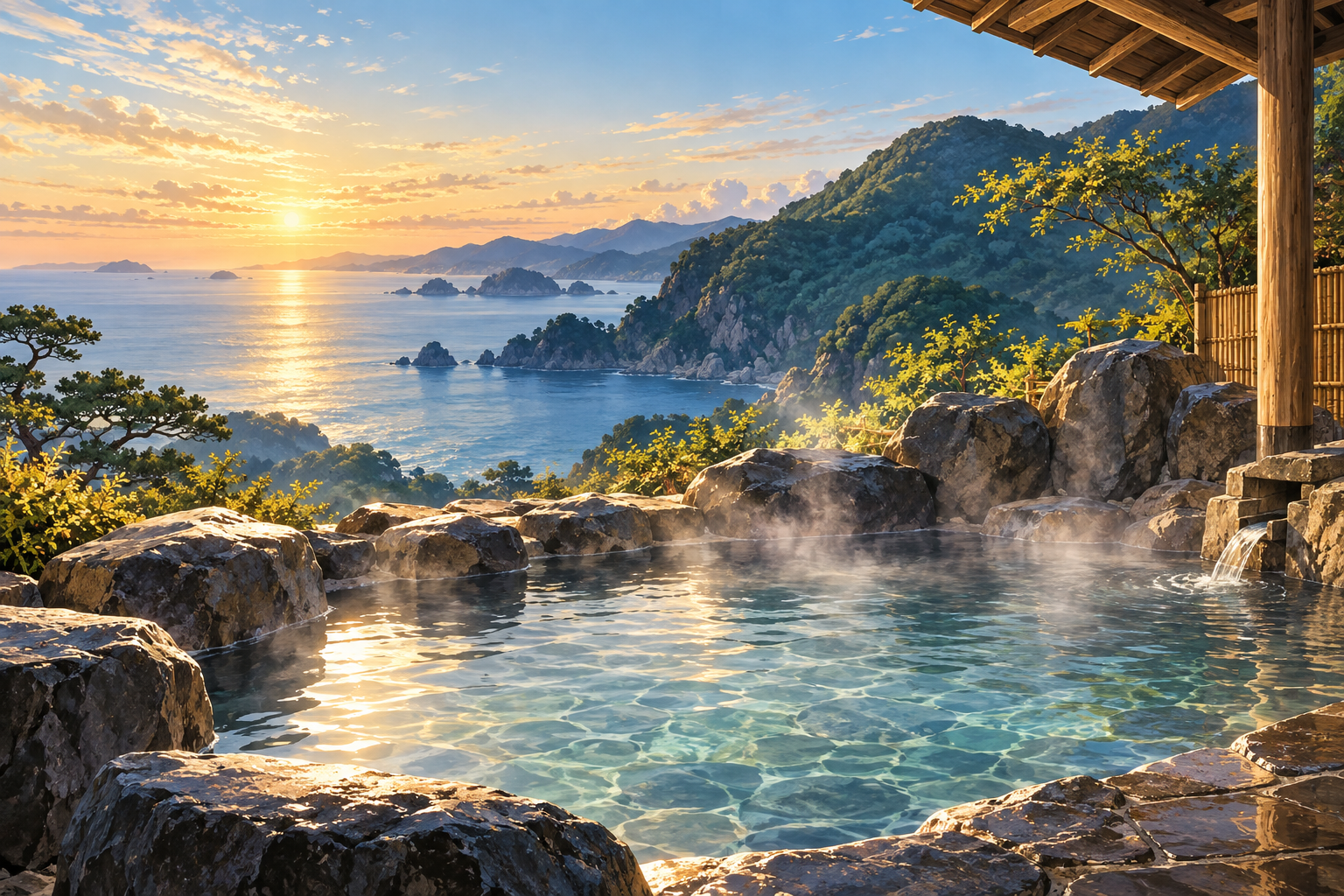
A sea view may draw you to a bath; a mountain road may lead you to another. Wakayama offers different settings, but a place name or a phrase such as “free-flowing spring water” does not tell you everything about the water.
This guide separates the spa area, the source and the bathing arrangement. It uses Shirahama, Ryujin, Katsuura and Kumano Hongu as starting points for reading analysis sheets and bath notices. It neither ranks facilities nor promises medical benefits.
Enjoying the scenery and checking the information belong together. You need not memorise every chemical term: start with where the water comes from, how it is used and whether bathing suits your condition today.
A spa town is not a spring classification
Names such as Shirahama and Ryujin help you choose a destination. A source name identifies a spring or well, while a spring classification describes analysed characteristics. The actual bath also has its own operating arrangements. Sharing a spa-town name does not establish that all facilities or baths have identical water.
Look beyond the regional name to the source identified on the bath notice. If several sources are used, ask which supplies the bath you plan to enter. Connecting the facility’s explanation with its analysis sheet is more informative than relying on a slogan.
Keep three questions separate: where will you travel, what water is supplied, and how is that water currently used in the bath?
Onsen does not simply mean warm water
Japan’s legal definition uses temperature or specified substances in water emerging from underground. The temperature criterion is at least 25°C when sampled at the source; water below that temperature may still qualify through its composition.
That 25°C criterion is not a recommended bathing temperature. Nor should the source temperature on an analysis sheet be treated as the temperature of the bath.
Start with five fields on the analysis sheet
Begin with the source name, source location, survey and analysis dates, source temperature and spring classification. The Environment Ministry’s form also includes pH and quantities of components. Read each number alongside the source and the date to which it belongs.
pH is one clue to the water’s characteristics, not a stand-alone quality score or a guarantee that it suits you. Read the classification, bathing precautions and current bath conditions too. Ask the facility about unfamiliar abbreviations or older terminology.
An analysis sheet describes the sample and analysis shown on it. Notices about added water, heating and other use arrangements help connect source data with the bath.
Compare the information—not the prestige
This table is a reading aid, not a ranking. Each type of information answers a different question.
| Information | What it tells you | What it cannot establish alone |
|---|---|---|
| Spa-area name | Where to start planning a trip | The water in every facility and bath |
| Source name and location | Where the water comes from | Current bath temperature and operation |
| Classification and composition | Analysed characteristics | Guaranteed medical benefits for an individual |
| Analysis date | When the analysis was performed | Every subsequent change |
| Added-water and heating notices | How the water is adjusted | The overall quality of the facility |
| Circulation and disinfection notices | Operating and hygiene arrangements | A complete safety guarantee |
| Bathing precautions | Conditions to observe | Individual decisions about illness or fitness |
Added water and heating are not a points deduction
Read the bath’s notices about added water, heating, circulation, bath additives and disinfection, including the stated reasons where provided. These explain use arrangements that source analysis alone cannot show. Ask the facility if wording is unclear.
Do not assume that added water makes a bath inferior, or that unheated water is suitable for everyone. Temperature and equipment conditions can require different arrangements. A “free-flowing” label does not remove the need to check temperature, hygiene information and your own condition.
Separate your preferences about water handling from whether you can use the bath comfortably. Clear explanations and accessible current precautions are useful information in their own right.
Shirahama: from the coastline to individual sources
The Nanki Shirahama Tourism Association lists bathing facilities separately from spring sources. Its official guide lets you check each facility and source individually. Use this distinction to look beyond the regional name.
If the sea view is the attraction, check the intended bath’s operating information and current notices, not just photographs. Where an outdoor bath is essential to your itinerary, prepare an alternative in case conditions or availability change.
Do not describe all Shirahama baths as one spring classification. Read the chosen facility’s analysis sheet and notices, and allow realistic travel and rest time if combining a bath with a coastal walk.
Ryujin: begin with the information for Motoyu
The Ryujin Tourism Association describes Ryujin Onsen Motoyu beside the Hidaka River and lists its water as a sodium hydrogen carbonate spring. This is information about Motoyu, not evidence that every nearby bath has identical conditions.
A description such as “beauty bath” is not a guarantee of skin benefits for every visitor. Read the spring classification and precautions, and remember that sensitivity and physical condition differ between people.
For a mountain destination, check the return journey as well as the outward trip. Use travel-date timetables and road information; do not create a plan that forces you to rush back after bathing.
Katsuura: sea-facing baths and mountain settings
Nachi-Katsuura’s official tourism information introduces baths with sea views as well as mountain settings. The area name alone does not establish the scenery or spring classification of an individual bath.
A hotel bath and a day-use bath may have different access arrangements. Check the operator’s current information on day use, opening and reception times, and any booking requirements.
If you combine the harbour, a meal and a bath, do not rush into the water after eating or drinking alcohol. Give the bath its own place in the itinerary, including time to rest.
Kumano Hongu: distinguish Yunomine, Kawayu and Wataze
The Kumano Hongu Tourism Association introduces Yunomine, Kawayu and Wataze separately. Their settings, backgrounds and uses should not be collapsed into one. Yunomine is associated with ritual purification on Kumano pilgrimages; Tsubo-yu is introduced as part of the World Heritage pilgrimage route. This does not mean that every bath is a World Heritage property.
Kawayu’s official description connects emerging hot water with the river. The winter Sennin-buro is seasonal, not a permanent bath available whenever you arrive. Weather can prevent use: check official operation updates before travelling and on the day.
Wataze’s official information includes open-air baths, bathing facilities and accommodation. Decide whether pilgrimage, walking or an overnight stay is your main purpose before choosing facilities.
Do not guess safe temperatures or access rules near the river or hot-water cooking well. Follow the manager’s instructions, and never prioritise the bath over flood or severe-weather warnings.
Before, during and after bathing
Check how you feel before bathing. Do not bathe after drinking alcohol, and avoid forcing a bath immediately before or after a meal or when very tired. Drink water before and after, wash first and acclimatise to the water’s temperature.
Longer is not automatically better. Temperature and health affect the strain, so this guide does not prescribe one bathing duration for everyone. Follow the bath’s precautions; stop and seek help if you feel unwell, and stand up slowly when leaving.
Seek individual medical advice if you have concerns relating to illness, medicines, pregnancy or recovery. This article does not replace diagnosis or treatment. Check supervision needs and facility rules when accompanying children or people who need assistance.
Do not drink bath water. Drinking spring water is a separate activity requiring a designated place and applicable precautions; a composition list does not establish that water is suitable for drinking.
Do not force a bath after alcohol or when unwell. Stop and seek help if you feel ill. Only use designated drinking-spring arrangements with the relevant precautions; never drink bath water.
Five checks when planning the trip
First, read the intended facility’s official information and check opening, reception and day-use conditions close to your travel date. Second, check the bath and source information. Third, compare the precautions with your physical condition.
Fourth, establish your transport and return journey in advance. Fifth, have an alternative for closures or unsuitable weather. Conditions at an outdoor or river-related bath may differ from those shown in a photograph.
This article deliberately omits fixed prices and bus timetables. Use the official links for changeable details. Useful questions include: which bath is available today, what are the day-use reception conditions, and where can I read the bathing precautions?
Short answers for reading the water
Knowledge should make a trip easier, not narrower. Let the scenery draw you in, then read the notices to choose a sensible way to enjoy the bath.
Do all Wakayama onsen have the same water?
No. Regional names help you find a destination; check individual sources and bath conditions in the facility’s analysis sheet and notices.
Is water below 25°C excluded from onsen?
Not necessarily. The legal definition also uses composition criteria, and sampling temperature is different from bath temperature.
Does free-flowing water make health checks unnecessary?
No. Read the operating information, bath temperature and precautions, and consider your condition.
Is Kawayu’s Sennin-buro always open?
It is seasonal and weather-dependent. Check official operation and access information before travelling and on the day.
Can I drink the spring water?
Do not drink bath water. Drinking spring water requires a designated place and separate precautions.
Sources and official information
Information checked: 2026-09-30
- S01 · Environment Ministry: definition of onsen
- S02 · Environment Ministry: bathing and drinking precautions
- S03 · Environment Ministry: spring analysis form
- S04 · Nanki Shirahama Tourism Association: facilities and sources
- S05 · Ryujin Tourism Association: Motoyu
- S06 · Nachi-Katsuura Tourism Organization: official guide
- S07 · Kumano Hongu Tourism Association: Yunomine
- S08 · Kumano Hongu Tourism Association: Kawayu
- S09 · Kumano Hongu Tourism Association: Wataze