

WAKAYAMA · THE SUSHI ATLAS
The Kishu Sushi Atlas: Narezushi, Sanma Sushi & Mehari Sushi
Ferment it. Season it with vinegar. Wrap it in a leaf.
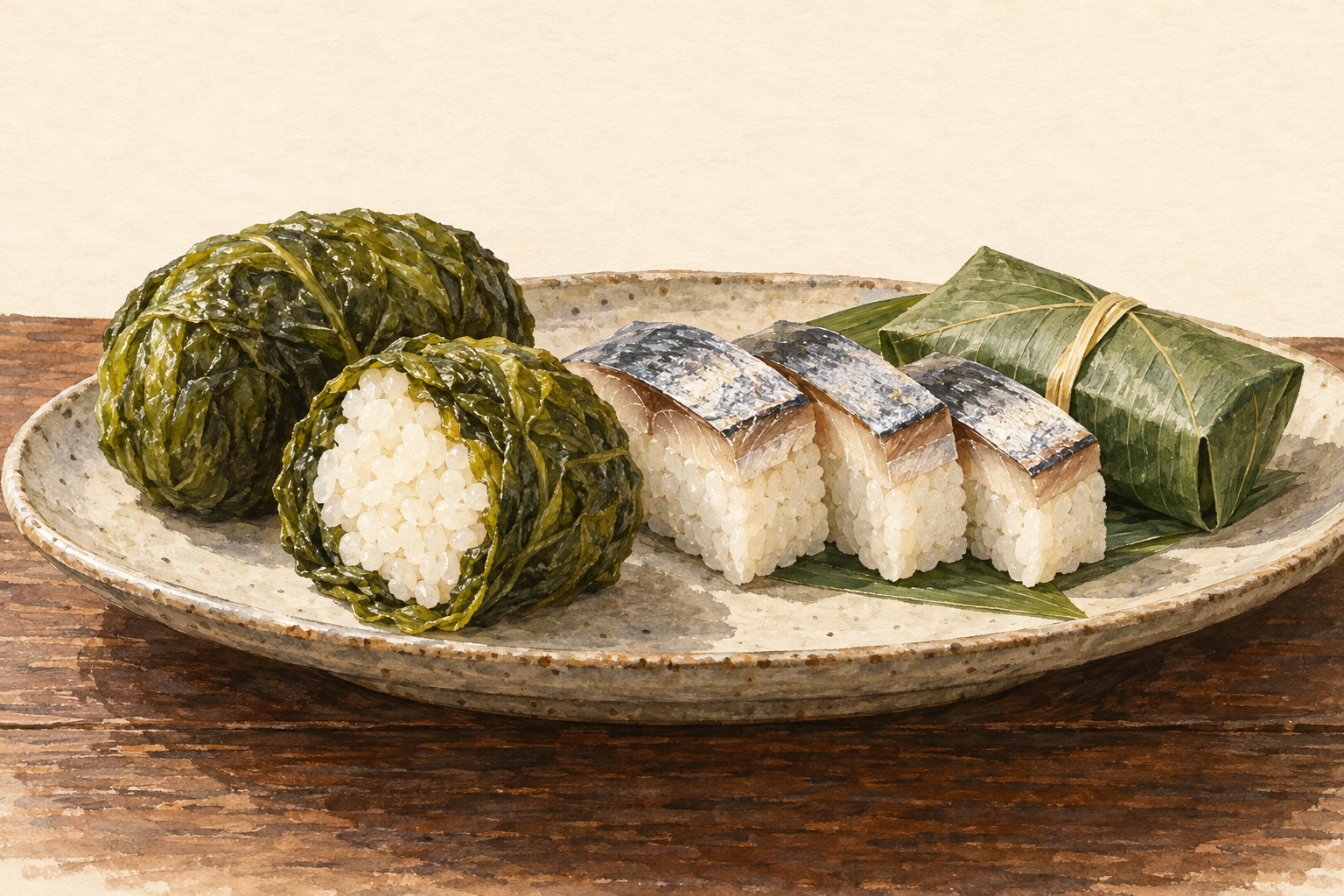
Ferment it. Season it with vinegar. Wrap it in a leaf.
Contents 12 CHAPTERS + 3 STORIES
SUSHI STORIES / 01
Sushi without fish?
Swipe sideways to read
Full comic transcript
- A traveler looks at rice wrapped in mustard leaves. “Is this sushi too?”
- The guide explains: “Mehari sushi. Rice wrapped in pickled mustard leaves.”
- The traveler asks: “So is the filling always the same?”
- The guide replies: “Plain or vinegared rice—and the fillings vary too.”
- The traveler asks at the counter: “What is in this one?”
- They agree: “Once you know the name, ask what is inside.”
SUSHI STORIES / 02
Before the sour taste
Swipe sideways to read
Full comic transcript
- The traveler asks: “Is all narezushi made the same way?”
- The guide shows a Yuasa example: “Some versions ferment without added vinegar.”
- Another recipe description: “The same name can also appear on a recipe using vinegar.”
- The traveler realizes: “The name alone does not tell us the process.”
- The guide suggests: “How do you make yours? That is a useful question.”
- Beside the wrapped sushi: “Different does not mean wrong.”
SUSHI STORIES / 03
One last question before taking it home
Swipe sideways to read
Full comic transcript
- The traveler considers buying sushi. “But we still have sightseeing to do…”
- The guide asks: “When will you eat it?”
- The traveler asks the seller: “How should I carry and store it?”
- They read the product label: “Check this product’s use-by date too.”
- The traveler says: “Its history as preserved food does not mean we can leave today’s product anywhere.”
- They agree: “Respecting local food includes looking after it properly.”
If sushi makes you picture a slice of fish on a small mound of rice, Wakayama offers a rewarding chance to look beyond that image.
Fermenting fish and rice, seasoning with vinegar, wrapping rice in leaves: different kinds of work sit beneath the same name. This atlas explores narezushi, hayanarezushi, sanma sushi and mehari sushi through their ingredients and preparation, not just their labels.
This is neither a ranking of famous restaurants nor a manual for fermenting food at home. It is a guide to asking one more question before you eat, and finding more to appreciate in a local meal.
Start with three questions, not a name
“What fish is this?” “Is the rice seasoned with vinegar?” “What leaf is this?” Asking these three questions gives you a better vocabulary for the differences in front of you.
Fermentation, vinegar and leaves are ways of exploring the subject, not mutually exclusive categories. Some sushi is wrapped in leaves before it ferments. Think of overlapping techniques rather than forcing every dish into a single box.
Narezushi: time becomes part of the dish
Yuasa Town’s official guide describes a version of narezushi fermented without added vinegar. Salted mackerel and rice are wrapped in ase leaves and placed in a barrel. In this example, a sour taste does not simply mean that vinegar has been added.
It would be equally misleading to extend that description to all sushi in Wakayama. Check how the particular product in front of you is made. The useful first step is not merely learning a name, but noticing what the name cannot tell you.
Do not infer the recipe from “hayanare” or “nare” alone
Wakayama Prefecture’s recipe titled “Saba no Narezushi” uses sugar and vinegar. Yuasa Town, meanwhile, describes fermentation without added vinegar. Even the headings of official sources show why a name alone cannot establish one universal process.
This atlas therefore does not assign a fixed number of days to every narezushi, or one prefecture-wide recipe to every hayanarezushi. Ask, “Do you use vinegar in this version?” or “Is this a fermented version?” That lets you understand local usage without declaring the local name wrong.
Sanma sushi: from a fish name to a local table
Japan’s Ministry of Agriculture, Forestry and Fisheries introduces sanma sushi as a traditional dish of southern Wakayama. It describes its development as preserved food and its place at gatherings such as autumn festivals and New Year celebrations. The published recipe combines Pacific saury, sushi rice and vinegar.
Instead of imagining raw fish simply placed on nigiri rice, look at the work of preparing the fish, pairing it with rice and shaping the dish. Knowing its place at festive gatherings can make a single slice feel connected to a larger occasion.
Seasonal fishing patterns or a region’s reputation are not a promise about what a particular shop can sell today. Ask the shop about its fish supply and sales dates.
Mehari sushi: still sushi, even when no fish is visible
Mehari sushi is rice wrapped in pickled takana mustard leaves. The ministry describes its spread as a packed meal eaten during fishing and mountain work in southern Wakayama. The rice may be plain or vinegared, and the fillings are not always the same.
“Sushi without fish?” is a good opening question. It is not a basis for claiming that every mehari sushi is fish-free. Check the filling and seasonings of the actual product. A dish name alone cannot guarantee that it meets someone’s dietary needs.
Several explanations for the name are also recorded, including an association with opening one’s mouth wide to eat it. Enjoy these as explanations or theories, not as a single established historical fact.
A comparison to help you ask better questions
This is not an exhaustive classification of Japanese sushi. Nor does it rank longer fermentation as more prestigious, or older methods as more correct.
| Dish or name | What the sources describe | A useful question to ask |
|---|---|---|
| Narezushi described by Yuasa Town | Salted mackerel and rice wrapped in leaves and fermented without added vinegar | How is your version made, and when is it best eaten? |
| Vinegar-based sushi, including versions called hayanarezushi | Check the name and process for the particular version | How do you use vinegar in the fish and rice? |
| Wakayama sanma sushi | A regional dish combining Pacific saury and rice | Where is the fish from, how is it prepared, and is it available today? |
| Mehari sushi | Rice wrapped in pickled mustard leaves; rice and fillings vary | Is the rice plain or vinegared? What fillings and seasonings are used? |
Look at the leaf
The ase leaves mentioned in descriptions of narezushi are not the same as the pickled mustard leaves used for mehari sushi. Being wrapped in a leaf does not make two foods the same dish. Check the serving guidance, including whether the leaf is packaging or part of what you eat.
For a photograph, comparing the parcel before and after opening can be revealing. But distinguish food served to you from merchandise you are not allowed to handle. Unwrapping someone’s stock without permission is not research; it is a nuisance.
A regional difference is not a mistake
Wakayama Prefecture’s food-culture archive presents local and ceremonial foods through community interviews. It links dishes to places, including hayanare sushi in Iwashiro, Minabe, and honnare sushi and takana sushi in Fushiogami, Tanabe.
The archive is not a tool for making every shop conform to one standard. It is an introduction to different names and eating occasions within the same prefecture. “This differs from the last shop” can begin a conversation; it need not end with “so it must be wrong.” Leave room for the maker’s explanation.
Before you buy food to take away
First consider when you will eat and where you will travel in between. Follow the individual product’s label and the seller’s advice on storage, use-by dates and transport. Its history as preserved food does not guarantee that a product sold today can be carried unrefrigerated for a long time.
Neither fermentation nor vinegar alone establishes the safety of a particular product. This article does not prescribe home-fermentation conditions or improvised storage periods. If you have dietary restrictions, ask specific questions. Food history and the conditions for safe handling are separate subjects.
If you would like to try making it
Wakayama’s official tourism site lists a hayanare sushi-making experience run by Kishu Taiken Koryu Yume Club. It offers a possible starting point for exploring the preparation with guidance.
Check dates, group sizes, prices, booking arrangements and allergy accommodations with the organizer before taking part. This article does not invent available sessions or prices, or claim that its author attended.
Read across the series: soy sauce, plums and fish
The aim of this series is not simply to put more local specialties on a shelf. For fish species and distribution, turn to the Fresh Tuna and Kuroshio Atlas. For seasoning and fermentation, explore the soy sauce and Kinzanji miso feature. Moving between them gives you different ways to understand one dish.
Do not, however, transfer advice about tuna directly to mackerel or Pacific saury. The ingredients and preparation are different. A worthwhile food journey teaches both where subjects connect and where they must remain distinct.
Frequently asked questions
Is narezushi always made without vinegar?
The example described by Yuasa Town is. Wakayama Prefecture also publishes a recipe under the same name that uses vinegar. Ask the maker rather than relying on the name alone.
Does mehari sushi always contain vinegared rice?
Both plain and vinegared rice are described. Check the particular shop or household’s version.
Can I avoid fish by choosing mehari sushi?
Check the fillings and seasonings individually. The name alone does not guarantee that it is fish-free or suitable for a particular diet.
Does longer fermentation mean better quality?
This article makes no such ranking. Different methods should not be reduced to one scale of superiority.
Can I carry it at room temperature because it is preserved food?
Its history is separate from the storage requirements of the product you buy today. Follow the label and the seller’s advice.
Sources and references
Information checked: 2026-09-28
- S01 · Yuasa Town: Seafood
- S02 · Wakayama Prefecture: Saba no Narezushi
- S03 · Ministry of Agriculture, Forestry and Fisheries: Sanma Sushi, Wakayama
- S04 · Ministry of Agriculture, Forestry and Fisheries: Mehari Sushi, Wakayama
- S05 · Wakayama Prefecture: Food Culture of Wakayama
- S06 · Official Wakayama Tourism: Hayanare Sushi-Making Experience