

WAKAYAMA · THE TUNA ATLAS
An Illustrated Guide to Fresh Tuna and the Kuroshio Current
Behind a single slice lies the work of the sea and the port.
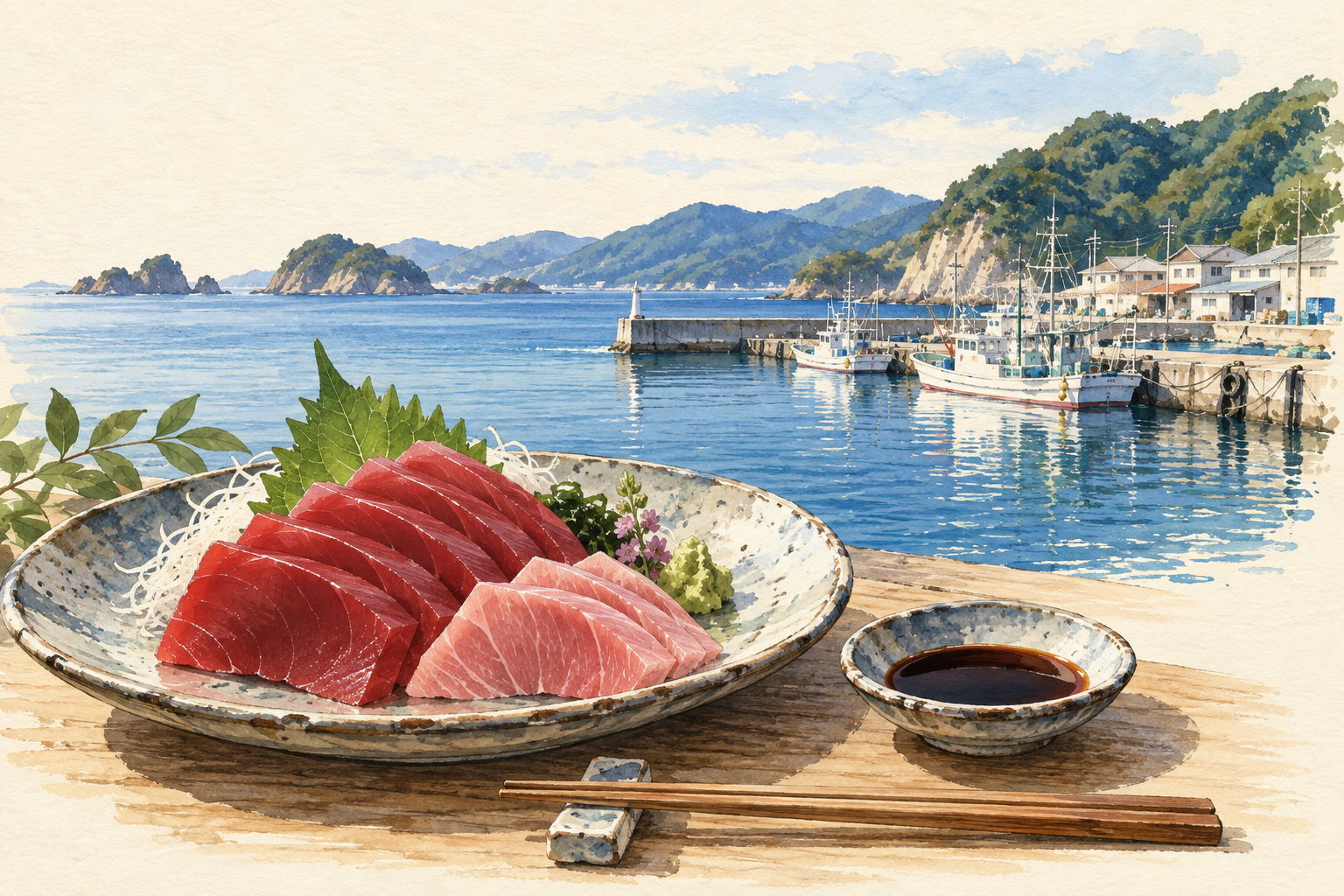
Behind a single slice lies the work of the sea and the port.
Table of Contents 14 CHAPTERS + 3 STORIES
TUNA STORIES / 01
Untangling the Names of Tuna.
Swipe sideways to read
Full comic text
- Is it all the same tuna? / Let’s look by species. / Each name holds different information.
- Bluefin, Bigeye, Yellowfin, Albacore. / First, the type of fish.
- Are red meat and toro fish names? / They’re about the cut and the fat. / Separate species from cut.
- Fresh, thawed. / Whether it was frozen is a separate axis. / Don’t rank by fresh vs. frozen alone.
- Landing site, capture sea area. / The port name alone doesn’t fix where it was caught.
- Please tell me the species and cut. / Having words to compare makes choosing fun.
TUNA STORIES / 02
From Sea to Port, a Relay of Work.
Swipe sideways to read
Full comic text
- What kind of current is the Kuroshio? / A warm current flowing south of Japan.
- Is all the fish at this port caught nearby? / The landing port and the sea it was caught in are different.
- Longline fishing attaches hooks to branch lines. / How it’s handled after the catch matters too.
- Chilled, not frozen, for transport. / The work that connects fresh tuna.
- At the port, fish are inspected, chosen, and passed on. / Tours are viewed from a designated spot.
- Behind a single slice, this kind of work. / Now the port scenery looks different, doesn’t it?
TUNA STORIES / 03
Before You Enjoy Eating.
Swipe sideways to read
Full comic text
- I’d like to make sashimi. / Please also check if it’s for raw eating and how it’s stored.
- After buying, avoid extra stops. / Keep it cold and refrigerate promptly.
- Is it fine if the color looks nice? / Color alone doesn’t tell you about safety.
- What about fish that was poorly temperature-controlled, if cooked? / Histamine doesn’t go away with cooking.
- Does soy sauce or wasabi make it safe? / It’s not a substitute for Anisakis prevention.
- Check use, storage, and expiration. / Peace of mind is part of enjoying the trip too.
When choosing tuna, many names line up on the price tag: Bluefin, red meat, fresh, thawed, Katsuura. Each word matters, but they are not actually the same kind of information. This guide unravels each name one by one, to reconnect Wakayama’s ports with its dining tables.
What you want to know while traveling surely isn’t just the price of the priciest slice. What kind of fish is it? Which part is it? How was it transported? Understanding even a little changes both the questions you ask at the counter and the way you enjoy the meal.
Here, we take as our starting point the Kishu Katsuura fresh tuna introduced by the National Federation of Fisheries Cooperative Associations. We do not feature fictional shops or invented market interviews; for facts about species and safety we link to primary sources, and for visiting conditions we link to official guides.
The First Minute: Sorting Names into Four Drawers
First, let’s separate the fish itself, the location on the body, the state of distribution, and location information. The phrase ‘Bluefin tuna’s red meat, fresh, from Katsuura’ opens each of these separate drawers. It is not ‘a type of tuna called toro.’
| Drawer | Example | What it tells you |
|---|---|---|
| Species | Bluefin, Bigeye, Yellowfin, Albacore | What kind of fish it is |
| Cut / fat characteristics | Red meat, medium fatty (chutoro), fatty (otoro) | What kind of flesh it is |
| Distribution state | Fresh, frozen, thawed | History of freezing or thawing |
| Location | Landing port / capture sea area | Distinguishing the port from the sea where it was caught |
The "Fresh" in Fresh Tuna Isn’t Only About Sashimi
In descriptions of Kishu Katsuura fresh tuna, it is noted that the tuna is chilled on board and landed without being frozen. In this context, ‘fresh’ does not simply mean eaten without cooking. It refers to a history of not having been frozen during distribution.
On the other hand, ‘eating raw’ in cooking refers to the state of preparation. Even thawed tuna can be sold for raw consumption. Conversely, the name ‘fresh tuna’ alone should not lead you to assume the product in hand is unconditionally safe to eat as sashimi. Be sure to check its intended use and storage conditions.
Turning this into a single ranking—’fresh is always delicious,’ ‘frozen is inferior’—obscures the differences in species, cut, processing, temperature control, and thawing. This guide treats fresh and frozen not as a ranking, but as information for comparison.
The Tuna You’ll Meet in Katsuura
The National Federation of Fisheries Cooperative Associations’ introduction to Kishu Katsuura fresh tuna features Bluefin, Bigeye, Yellowfin, and Albacore (also called Binnaga). What arrives varies by day, so there is no guarantee that all species will always be available.
Knowing the names isn’t about winning a memorization contest—it’s about setting a common starting point for comparison. Even the same ‘red meat’ may differ depending on species, individual fish, and cut. You can start simply by asking a shop, ‘What kind of tuna is today’s?’
| Japanese name | English name | Clues to reading the name |
|---|---|---|
| Kuromaguro | Bluefin tuna | Also called "Honmaguro" (true tuna) |
| Mebachi | Bigeye tuna | Named for its large eyes |
| Kihada | Yellowfin tuna | Named for its yellowish fins and coloring |
| Binnaga / Bincho | Albacore | Characterized by long pectoral fins |
Red Meat and Toro: Not Different Fish, But a Way of Reading the Flesh
Red meat, chutoro, and otoro are not terms classified alongside species names. They are terms for reading the location on the body and how the fat is distributed. Even the Fisheries Agency’s cut diagrams separately introduce back-side red meat and belly-side toro.
That said, it would be hasty to apply a single diagram directly to every fish. Species and individual fish differ, and how shops divide cuts also varies. Please do not treat this as a guarantee that ‘any chutoro has the same amount of fat.’
If you want to convey your preference, rather than talking about higher or lower price, it helps to say things like ‘I prefer less fat,’ ‘I want to enjoy a smooth texture,’ or ‘I want to use it for a cooked dish.’ This isn’t a ranking of taste, but a way to match how you’ll eat it with your preference.
| Term | Axis to look at | Sample question at the counter |
|---|---|---|
| Red meat | Low-fat red flesh | Which species is this red meat from? |
| Chutoro / Otoro | Fat distribution and cut | How strong is the fattiness? |
| Saku (block) | Cut shape / sales unit | Is this suited for sashimi or for cooking? |
The Port of Katsuura and the Sea Where the Tuna Once Swam
The port of Nachikatsuura is a gateway to learning about fresh tuna. However, ‘landed at Katsuura’ is not the same as ‘caught right off the coast of Katsuura.’ Reading the fishing area, the port the boat returns to, and the place of processing and sale as separate things gives depth to the language of origin.
A port is not just a place where fish change hands; it is also a place of work—sorting, evaluating, and passing fish on to their next destination. When visiting as a tourist, it’s important to keep a respectful distance so as not to interrupt that work.
This page does not encourage travel with headlines like ‘Japan’s number one.’ To use a ranking meaningfully, you would need to align factors such as whether the subject is fresh fish, which species, quantity or value, and which year’s statistics. The appeal of visiting a port can be conveyed without vague rankings.
The Kuroshio Current Is Not a Tuna-Only Conveyor Belt
According to the Japan Meteorological Agency, the Kuroshio Current flows from the East China Sea through the Tokara Strait, then northeastward along Japan’s southern coast. It carries warm seawater and heat, and is involved in marine environments and the distribution of fisheries resources.
However, please do not assume that the single blue line drawn on a map represents a path that every tuna follows the same way. The position and strength of the current change, and the ecology differs by species. You cannot pinpoint where the fish in front of you was caught based solely on an explanation of the Kuroshio Current.
Even when viewing the sea as scenery on your trip, do not judge today’s actual current path from this guide alone. If you want to know current conditions, refer to the Japan Meteorological Agency’s ocean current information. Keep the guide’s basic knowledge separate from continuously updated observational data.
The Work Continues After the Catch
The introduction to Kishu Katsuura fresh tuna describes longline fishing, a method in which branch lines with hooks and bait extend from one long main line to target fish. Even in fishing where a single hook lands a single fish, quality cannot be discussed apart from the subsequent processing and refrigeration.
What readers should pay attention to is the space between ‘catching’ and ‘delivering’: the boat, the port, transport, the shop, and the trip home after purchase. If temperature control breaks down anywhere along that chain, an impressive place name alone cannot protect the fish.
The comic is an explanatory story meant to convey this chain. It is not a record based on interviews with a specific boat, fisherman, or fish shop, and it does not include unverified figures such as days at sea or the temperature inside a vessel.
Don’t Force Fresh, Frozen, and Farmed onto the Same Scale
‘Fresh or frozen’ is a matter of distribution and storage; ‘wild or farmed’ is a matter of production. Since these are different axes, you cannot say ‘farmed means frozen’ or ‘wild means fresh.’ Check each piece of information you want to know, one at a time.
Freezing technology plays a role in preserving fish and enabling distribution. The Ministry of Agriculture, Forestry and Fisheries also offers advice on watching for drip loss when choosing thawed products. However, appearance is a clue for judging quality, not proof of safety against food poisoning.
If you want to compare by tasting, it’s best to match conditions like species and cut as closely as possible. The preference you feel from eating two dishes under different conditions is valuable, but don’t let that alone decide the overall superiority of fresh versus frozen. That approach will serve you better the next time you choose.
| What to compare | Item to check |
|---|---|
| Difference in fish | Species / cut |
| Difference in how it arrived | Explanation of fresh / frozen / thawed |
| Difference in how it was raised | Explanation of wild / farmed |
| Compatibility with how you’ll eat it | Whether it’s for raw consumption or cooking, per the shop’s guidance |
| Ease of taking it home | Cold storage conditions, time to get it home, availability of shipping |
At the Counter, Ask About Use, Not Just Color
A beautiful red color may catch your eye, but color alone cannot tell you the species, fat content, best time to eat, or safety. First check the name, intended use, storage method, and expiration, and ask the seller if you’re unsure.
The Ministry of Agriculture, Forestry and Fisheries’ guide to selecting fish explains that the grain visible in a block relates to mouthfeel when eaten raw versus suitability for cooked dishes. Rather than treating visible grain as simply a flaw, this is a way to match it with what you want to make.
If you’re traveling, it’s reassuring to think about how you’ll get the fish home before you buy it. It’s best to avoid carrying a chilled item around on a long sightseeing trip if you haven’t decided when you’ll eat it. If you’re worried about transport, you can choose to eat it at the shop, ask about cold storage or shipping, or simply decide not to buy it this time.
| What to check | Short way to ask |
|---|---|
| Species and cut | What kind of tuna is this, and which part? |
| Intended use | Is this for sashimi or for cooking? |
| Storage | How should I chill this to take it home? |
| Expiration | If stored as labeled, how long will it keep? |
| Shipping | Is refrigerated or frozen shipping available? |
Savor a Dish in Words, Not Rankings
When eating, before scoring the taste, why not try putting into words what you felt—the texture, the sense of fat, the aroma, the way it was cut? If you gain even one more reason for ‘I like this one,’ that comparison of tastes becomes plenty interesting.
One way to enjoy it is not pouring soy sauce over the whole plate from the start, but using it little by little according to taste. This isn’t the one correct answer—it’s a suggestion for discovering the flavors of both the fish and the seasoning. If you’d like to learn more about Wakayama’s soy sauce, see the guide to soy sauce and kinzanji miso in the same series.
Using cuts suited for cooking is also a valid way to enjoy tuna. However, this page is not guidance for rescuing fish of uncertain storage condition by cooking it. Please follow the safety cautions in the next section separately from any cooking method.
Check Chilling and Raw-Edibility Separately
In red-fleshed fish such as tuna, improper temperature control can increase histamine, potentially leading to food poisoning. The Tokyo Metropolitan Bureau of Hygiene and Public Health warns that once histamine has formed, it is not broken down by cooking. You cannot say ‘it’s fine if you cook it.’
Follow the storage conditions indicated on purchased fish, and refrigerate or freeze it properly as soon as possible. Do not rely on color or smell alone as proof of safety, and do not taste-test something whose storage condition is questionable to check it. Follow the specific storage period given by the product and seller.
Another caution when eating raw fish concerns Anisakis. Tokyo notes that the amounts of vinegar, soy sauce, or wasabi typically used in cooking do not kill it. Do not treat marinating (zuke) as a substitute for proper safety processing. Nor does this mean all fish carry the same level of risk regardless of species or processing conditions.
If you need to avoid raw food or have dietary restrictions, please follow medical or official advice suited to you. This guide does not make judgments about intake amounts or diagnoses for individual health conditions.
Do not assume that fish of uncertain storage condition can be made safe again by cooking or marinating. Verify suitability for raw consumption and manage temperature as separate matters.
If Visiting Katsuura, Start by Watching the Market at Work
The Nachikatsuura Tourism Association offers a guided experience of watching the fresh tuna market auction. Official information also notes that it uses a bidding system, so keep that separate from any imagined idea of movie-like shouted exchanges—that isn’t guaranteed.
Wakayama Prefecture’s official tourism site lists tours where you can view the auction from the second floor of the market. Please check the official information before participating for viewing location, dates held, reservation conditions, fees, and languages supported. This article does not fix an itinerary around fees or meeting times, which are subject to change.
The market is not a tourist set piece—it is a working site. Follow the guide’s or facility’s instructions regarding accessible areas, photography, and conditions for companions. Do not enter work areas or touch the fish on your own judgment. This kind of distance matters especially on a trip meant to observe people at work.
| Before departure | On the day |
|---|---|
| Check the official information for dates, reservations, and meeting conditions | Observe from the designated viewing area |
| Check conditions for photography and companions | Do not interfere with work or foot traffic |
| Check the shop’s current information for meals and shopping | Buy with cold storage and your return trip in mind |
A Single Kind of "Tuna" Can’t Tell the Whole Story of the Ocean’s Future
Even when considering tuna resources, separating species from sea area is the starting point. The Fisheries Agency introduces international management of tuna and similar resources through frameworks of regional fisheries management organizations by sea area. A statement like ‘tuna overall has increased’ or ‘wild always means sustainable’ does not settle the matter.
A small step readers can take is to confirm the name and origin, and increase conversations with sellers who can explain them. If you’re interested in certification or resource status, please follow up with the latest information on the target species and relevant systems. This page does not certify any specific product as sustainable.
Knowing one slice is not the same as knowing everything about the ocean. Still, if your questions continue on to the species, the cut, the work of transport, and the scenery of the port, your food journey deepens a little. Next time you see tuna in Katsuura, try asking its name first.
Untangling Common Questions, Briefly
Are fresh tuna and sashimi the same thing?
No, they are not the same. Here, ‘fresh tuna’ refers to tuna distributed without freezing. Whether it can be eaten as sashimi is a separate matter to confirm based on intended use and processing.
Does toro mean bluefin tuna?
Toro is not a species name. It’s a term for fatty flesh; the species must be asked about separately.
If it says ‘Katsuura-caught,’ was it caught right off Katsuura’s coast?
The port and the capture sea area are not the same information. The landing location alone does not determine the fishing ground.
Is fresh always better than frozen?
This guide doesn’t assign such rankings. We compare conditions like species, cut, processing, temperature control, and thawing separately.
Does marinating in soy sauce make it safe?
It is not a substitute for proper safety processing. You cannot expect ordinary seasoning to counter Anisakis, and it does not resolve issues with temperature control.
Can I freely walk around during a market tour?
Do not enter work areas on your own judgment; follow the official viewing guidelines and the guide’s instructions.
Sources and References
Date Information Verified: 2026-09-27
- S01 · National Federation of Fisheries Cooperative Associations | Kishu Katsuura Fresh Tuna
- S02 · Japan Tuna Fisheries Cooperative Association | Types of Tuna
- S03 · Ministry of Agriculture, Forestry and Fisheries | Eat Fish / How to Choose Fish
- S04 · Fisheries Agency | Major Tuna Species and Cut Diagrams
- S05 · Japan Meteorological Agency | The Kuroshio Current and Related Oceanic Knowledge
- S06 · Japan Meteorological Agency | Ocean Current Diagnostic and Forecast Information
- S07 · Nachikatsuura Tourism Association | Experiences and Market Tours
- S08 · Wakayama Prefecture Official Tourism Site | Guided Market Auction Tour
- S09 · Tokyo Metropolitan Bureau of Hygiene and Public Health | On Histamine Food Poisoning
- S10 · Tokyo Metropolitan Bureau of Hygiene and Public Health | Anisakis Food Poisoning
- S11 · Fisheries Agency | International Resource Management